Top 10 Mortgage and Home-Buying Myths & Truths

Mortgage and Home-Buying Myths & Truths

Buying a home is usually the biggest purchase people make, and the path to arriving at the right decision is often daunting. This is because even a slight oversight may lead to negative consequences in the future. To make matters even more complicated, prospective homebuyers have to find their way around various home buying myths.

While family and friends offer well-meaning advice, with some even suggesting that buying a house is a waste of money, bear in mind that not all you hear about buying a home might be true. Real estate agents and mortgage providers do what they can when it comes to debunking home buying myths, and most experts from this realm mention having to deal with similar misconceptions.

1. Renting is Cheaper Than Buying

Whether it’s cheaper to buy a home than continue living on rent depends on where you live. According to a report released by Realtor.com, buying a home in January 2020 was as affordable as renting, if not more, in 15 of the country’s 50 largest metros. Bear in mind that this only highlights the monthly costs involved in buying a home and living on rent. While the rent you pay is never coming back, your mortgage payments help you build equity in your home.

2. You Start the Process by Looking for a Home

One of the top myths about buying a home is that you need to start the process by looking for a suitable property. However, this might not be in your best interest because you may set your mind on a house, only to find out you do not qualify for the required mortgage amount. In this case, you’ll need to begin the house-hunting process again, already having wasted valuable time.

Ideally, you should begin the home buying process by ensuring that your finances and your credit score are in order. Then, you seek preapproval for a mortgage. Once you know how much you qualify for, look for homes accordingly.

3. Preapproval Comes with a Guarantee

Unfortunately, getting preapproved for a mortgage does not guarantee that a lender will approve your loan. For example, if your employment status changes after you receive preapproval, a lender might reconsider your application. This is also the case if there’s a change in your income or overall financial situation. While lenders review your creditworthiness before granting preapproval, they do so during the final underwriting as well.

4. A 20% Down Payment is Necessary

When it comes to the most commonly spread home buying myths, this one probably takes the cake. Sure, making a 20% down payment is a good idea. However, you may qualify for different types of mortgages by paying less than 20% upfront. When it comes to how much down payment you need, it boils down to your specific situation and the type of mortgage you’re after.

    • Conventional mortgage. You need to pay 5% to 15% as down payment, and you also need to account for private mortgage insurance (PMI).
    • S. Department of Veterans Affairs (VA) loan. Eligible applicants don’t need to make any down payment.
    • S. Department of Agriculture (USDA) loan. If you qualify, you may choose to make no down payment at all.
    • Federal Housing Administration (FHA) loan. These loans come with a minimum down payment requirement of 3.5%.
    • Jumbo loans. Down payment for these loans can be as low as 10%.

In addition, first-time homebuyers should ideally check if they qualify for any down payment assistance programs run by state and local government agencies.

5. People With Poor Credit Cannot Buy Homes

There is no minimum credit score that will disqualify you from buying a home, although the lower it is, the more difficult it becomes to find a mortgage. If you’re looking for a conventional loan, your credit score should ideally be over 620. However, people with slightly lower scores who have high incomes or are willing to make large down payments might also qualify.

When it comes to FHA loans, people with credit scores of over 580 may qualify if they meet a few other eligibility criteria. This is also usually the case with VA loans. If you wish to get a USDA loan, know that most lenders require scores of 640 or higher.

6. People With Student Loans Cannot Get Mortgages

Whether or not people who have student loans may qualify for mortgages depends on their specific situations. For example, if you’ve been making all your payments on time, have a low debt-to-income ratio, and have a good credit score, you might find it easy to qualify for a mortgage. However, the reverse holds true as well.

If you have a student loan, make sure you look at your DTI before applying for a mortgage. You should ideally try to get it to less than 36%, although some lenders consider applicants with DTIs as high as 43%. The lower it gets, the better.

7. The Down Payment is the Only Upfront Cost

Your down payment accounts for a major chunk of the money you need to pay upfront, but you need to account for other costs as well. As a buyer, you are also responsible to cover your loan’s closing costs. Closing costs may vary from 3% to 6% of a home’s selling price, and the state in which you purchase a home also has a bearing on how much you need to pay.

8. Your Mortgage is Your Only Expense as a Homeowner

One of the key facts about buying a house is that you need to account for more than just your monthly mortgage payment.  For example, you need to pay property taxes that vary based on where you reside. If you get a conventional mortgage and your down payment is less than 20%, you need to pay extra for private mortgage insurance (PMI).  Buying a house also requires paying homeowners insurance, which, according to Policygenius, averages at $1,899 per year.

As a homeowner, you’re responsible for your home’s ongoing maintenance.  In this case, you may expect to spend around 1% to 2% of the home’s buying price each year. Depending on where you buy a home, you might also need to pay homeowners’ association (HOA) or condominium association fees.

9. A 30-Year Fixed-Rate Mortgage is the Best

While 30-year fixed-rate mortgages find several takers, they don’t work equally well for everyone, which is why this is among the top mortgage myths. Bear in mind that you get several alternatives from which to choose. These include adjustable-rate mortgages, balloon mortgages, interest-only mortgages, as well as 10-. 15- and 20-year fixed-rate mortgages.

People who opt for 30-year fixed-rate mortgages do so because of two basic reasons. First, the interest rate remains the same over the course of the loan term, so there’s no variation in monthly payments. In addition, the monthly payments of a 30-year mortgage are noticeably lower than that of a 10- or 20-year mortgage.  However, the interest you end up paying for a 30-year mortgage will be significantly higher than that of a 15-year mortgage.

The mortgage that works best for you depends on your financial situation as well as the duration you plan to stay in the house you purchase. Consequently, it’s ideal that you learn about the effect of interest rates and loan terms on mortgages before making a decision.

10. Select the Lender With the Lowest Interest Rate

Interest rates play a key role in deciding which mortgage provider to select, but there are other factors to consider as well. For instance, a lender might offer a low interest rate and make up for the same by charging steep fees. When you’re comparing lenders, you should stick to looking at the annual percentage rate (APR) because it gives you an indication of how much you’ll end up paying as interest and fees combined.

Given that paying off a mortgage is typically a long-drawn affair, it’s important to look at the level of customer service a lender provides. Selecting the right mortgage provider also requires looking at flexibility in terms, which may come in the form of weekly/biweekly/monthly payments, payment pauses, and redraw facilities.

11. Interest Rate Are Increasing

This makes it to the list of myths about home ownership because although interest rates increased significantly in 2022, one needs to look at the bigger picture. For instance, 30-year fixed-rate mortgages came with interest rates of around or over 7% during the 1990s, and stood largely above 6% before the Great Recession (2007 to 2009).

In addition, while the average interest rate for a 30-year fixed-rate mortgage peaked at 7.08% in October and November 2022, it dropped to 6.09% in the week ending on February 1, 2023. Most experts predict that this number may vary from 5.5% to 6% for the rest of the year.

12. Buying a Fixer-Upper Saves Money

If you think you might be able to save money by buying a home that is a bad shape and fixing it on your own, you might want to give your decision some serious thought. For starters, you should have some knowledge about construction and making renovations, as well as the required skills and tools.

What attracts homebuyers to fixer-uppers is that they get the opportunity to spend less upfront. However, you need to account for the money you’ll need to spend on repairs and renovations, because the total cost may exceed the cost of a comparable home that’s ready to move in soon after the purchase.

13. There’s No Need for Professional Home Inspections

This is one of those home buying myths that might end up costing you a tidy sum in the long run. Even if you think another prospective buyer might beat you to the finishing line by choosing to skip the home inspection stage, it’s best to err on the side of caution. Remember that checking a home on your home is not the same as getting a professional to carry out the process.

While a professional home inspection comes at a cost, it may help you save money in the long run or even steer clear of making a bad decision. The American Society of Home Inspectors (ASHI) Standard of Practice indicates that a home inspection involves checking a home’s:

    • Interior
    • Exterior
    • Structural system
    • Roof system
    • Plumbing system
    • Electrical system

14. You Should Buy a Home During the Spring Season

Sure, the real estate industry is typically buzzing with activity during the spring season, but this does not mean you need to restrict yourself to buying a home during this period. Besides, the truth about buying a house is that you don’t really have to wait for the perfect time to move forward.

Looking to Purchase a Home on Long IslandContact Us

While the spring season usually sees more real estate transactions than other periods, high competition may leave little room for negotiation. The fall, on the other hand, usually brings with it a fair amount of inventory along with reduced competition. This means you may land a good deal even if you choose to buy a home in the fall.

15. Schools Don’t Play a Role if You Don’t Have Children

Prospective homebuyers who don’t have children might have heard that there’s no need to pay attention to schools. However, there’s more to schools in a neighborhood than just educating children. This is because the presence of good schools is typically an indication of good neighborhoods. Besides, homes in reputable school districts tend to have higher values, and they usually manage to find takers even the real estate market is down.

Conclusion

Debunking home buying myths is crucial because there is no dearth of prospective homebuyers who approach the process with various misconceptions. For example, while some might lead you to believe you’re better off as a renter, you might actually benefit by buying a home instead.

More often than not, working with a realtor or a real estate agency is ideal. This is because you then have a professional doing all the groundwork for you as well as someone you may turn to for advice. Once you decide you wish to buy a home, it’s also important to find a suitable lender and get preapproval. This way, you know just how much money you may get in the form of a loan.

What to Consider Before Buying a Rental Property

Buying a Rental Property

If you’re thinking of buying a rental property, it’s time to become familiar with all of the quirks of investing in real estate.

Key Takeaways:

    • Renting out property seems like an easy way to make money, but many things can complicate the process.
    • Get up to speed on tenant-landlord laws so you don’t violate any legal rules.
    • Keep a cash reserve on hand for surprise expenses. This isn’t a side business you should be running paycheck to paycheck.

You know why you want to invest in a rental property. You envision making passive income, raking in the dough, as your tenants pay you every month. It’s a smart goal, and you certainly can make money as a real estate investor, but as anyone will tell you, it isn’t exactly passive, easy or cheap. You have to spend money before you make money, and you’ll have to spend money while you’re making it, too.

Still, if you’re thinking of buying a rental property, it’s time to become familiar with all of the quirks of investing in real estate.

If you’re looking at buying a rental property, be sure to consider these things first:

  • Know your costs.
  • Have a great real estate lawyer.
  • Make sure your property isn’t subject to rental restrictions.
  • Be mindful of surprise costs.
  • Understand what being a landlord really means.
  • Don’t assume hiring a property manager is a perfect solution.
  • Prepare for your rental to sit vacant.
  • Make sure you have plenty of cash reserves.

Whether you’re buying a house, an apartment building, a condo, a townhouse or whatever piece of property you’re zeroing in on, it’s important to purchase a rental property you can comfortably afford. But many first-time investors don’t realize what they’re getting into. There are the closing costs, which can’t always be financed. There may be a hefty down payment. There’s the monthly mortgage. You need to determine what the rent is going to be. This is all just for starters.

The rent amount can take a while to determine. “Many investors subscribe to the 1% rule, which suggests that monthly rent should be roughly 1% of the property’s purchase price. That would mean a $200,000 home should rent for roughly $2,000 per month,” says Debbie Fales, communications and marketing manager for Navigator Private Capital, a real estate lender in Annapolis, Maryland.

“While this might be a helpful rule of thumb, it’s rarely that simple,” Fales says. “We suggest diving deeper into listing aggregators like Apartments.com or Rent.com and comparing similar properties to find the going rental rate.”

Paul Dashevsky is a Los Angeles-based real estate investor and the co-CEO of GreatBuildz.com, a service that matches homeowners with general contractors, and co-CEO of MaxableSpace.com, which builds and manages guest homes and other tiny house projects.

He advises: “Don’t buy based on emotion and don’t overpay. You’re not living in this home, so the only important metric is what your net revenue will be.”

Nicole Rueth, founder of The Rueth Team, a mortgage lender in Englewood, Colorado, says, “Run the numbers like a business. Higher prices are here to stay, so instead of waiting for prices to drop, find the properties that cash flow with a little creativity. They’re out there; I know because I’m helping investors find them.”

But she warns, “If it doesn’t cash flow on paper, don’t buy it.”

Rueth says too many novice investors get caught up in making the home a little too perfect before renting it out. That’s admirable to be conscientious, but it could financially wipe you out if you’re not careful.

“Remember, you don’t live there. Renovate to your market, not your tastes. You’re not moving in,” she says. “If it makes you money, it’s pretty enough.”

You’ll want a skilled real estate attorney reviewing your contract with the entity you’re purchasing from, as well as when the one you’re drafting for your tenants. Every state has its own approach to the landlord-tenant relationship, and you don’t want to be be a landlord who breaks a bunch of laws. There are plenty of ways you can violate the law, too, from charging too high of a security deposit to not making necessary repairs in a timely manner.

But a good lawyer is just the start.

“Build your A-team,” Rueth says. “Lenders, agents, handymen, CPA and property managers are critical to not only a successful rental but a scalable business.”

Homes that belong to a homeowners association, also known as an HOA, can be challenging to rent out, says Dashevsky.

“If your property is in an HOA, you have little control of the association costs and how they might increase over time,” he says. This means HOA costs could affect what rent you charge your tenant or wreck your profit margin.

“Also,” Dashevsky says, “your tenant could run afoul of the HOA rules.”

Dashevsky isn’t a fan of renting out a home with a swimming pool. Sure, you can charge more, but only in theory, according to Dashevsky. “I find that you don’t get an increase in rent for a home with a pool,” he says.

He also doesn’t like what a pool will do to your insurance, and then there’s the cost of maintaining the pool that you have to think about.

Surprise costs can slash your profits and, in some cases, exceed them. These can range from rising property taxes to the cost of maintenance and repairs.

“It’s hard to expect the unexpected,” Fales says. Yet you need to do just that when you rent property.

“So it pays to secure rental property insurance, commonly referred to as a landlord policy,” Fales says.

She also recommends putting aside money for maintenance, regular things you know you’ll probably have to pay for, like maybe an exterminator or a lawn mowing service, to surprise maintenance costs, like a plumber or a roofer.

“And, of course, you should have a fair idea of utility costs and energy usage before you pull the trigger,” Fales says.

Becoming a landlord doesn’t just mean taking on the expense of maintaining a rental property. It also means having to be available at all times and deal with tenant issues as they arise. If there’s a plumbing, heating or cooling problem, for instance, you’ve got to promptly fix it – or hire someone to. You’re potentially on call, 24/7.

If that excites you, and it may, especially if you’re good at making repairs or a real people person, then you have nothing to worry about.

It’s certainly possible to minimize your work as a landlord by hiring a property manager to oversee your rental. But there are pros and cons to such a move.

“Property managers just don’t have the same incentive as you to manage the property at its highest efficiency,” Dashevsky says. “If possible, manage the property yourself.”

But Rueth says, “Don’t assume self-managing saves you money. If managing tenants stresses you out, costs you time or makes you hate investing, you’re paying a price either way. Know your strengths and hire for the rest.”

When it comes to making money on a rental, a lot of the financial upside you see is apt to come in the form of property appreciation. But you’ll still need to cover your costs along the way, and even when there’s demand for housing, you still could find that your property isn’t always going to be rented out.

“For a rental investment to pay off, you need tenants,” Fales says. “So you’ll want to consider the housing supply in the area in relation to the estimated demand. You want your estimated vacancy rate to be as low as possible, but it should also be based in reality. We advise clients to take advantage of public data by consulting the U.S. Census Bureau, where they list vacancy rates by region.” (You can find that information here.)

Dashevsky has a suggestion, especially if you find your properties are sometimes vacant.

“Rent your property slightly under market, like $50 to $100 under the peak market rent you believe is the right price. It’s not a large amount to lose every month, and it will get your unit occupied faster,” Dashevsky says. This will mean more rental income, he adds, and you’ll increase your odds of the tenant staying longer, which also will mean additional steady rental income.

Because owning a rental property can cost more than expected, and you can have those surprise costs mentioned earlier, it’s important to have plenty of cash reserves on hand to cover any expenses as they arise. You might have to pay for a sudden repair, or you might end up with an apartment that remains vacant for a few months until a major issue is resolved.

Or, hey, maybe it’ll all happen at once.

“Don’t underestimate reserves,” Rueth says. “A water heater, roof leak or tenant turnover will eat your profits if you didn’t plan for it.”

Having a solid financial cushion in the bank can help you avoid cash flow issues when unexpected situations arise. And it might buy you more peace of mind. That said, when you own a rental property, while you can certainly become rich – that’s why renting properties is a thing – there really are endless opportunities for something to go wrong, and you’ll need to come to terms with that before taking the leap.

Source: realestate.usnews.com ~ By  ~ Image: Canva Pro

Is It Better To Rent or Buy a Home?

Is It Better To Rent or Buy a Home?

You’ve probably asked yourself lately: Is it even worth trying to buy a home right now?

With high home prices and stubborn mortgage rates, renting can seem like the safer choice right now. Or maybe your only choice. That’s a very real feeling. And perhaps buying today isn’t your best move; it’s not for everyone right away. You should only buy a home when you’re ready and able to do it, and if the timing is right for you.

But here’s the thing you need to know about renting.

While it may feel like a safer bet today – and in some areas might even be less expensive month-to-month than owning – it can really cost you more over time.

In fact, a recent Bank of America survey found that 70% of aspiring homeowners worry about what long-term renting means for their future. And they’re not wrong.

Owning a home may seem way out of reach, but if you make a plan now and steadily work toward it, homeownership comes with serious long-term financial benefits.

Homeownership Builds Wealth Over Time

Buying a home isn’t just about having a place to live – it’s a step toward building your future wealth.

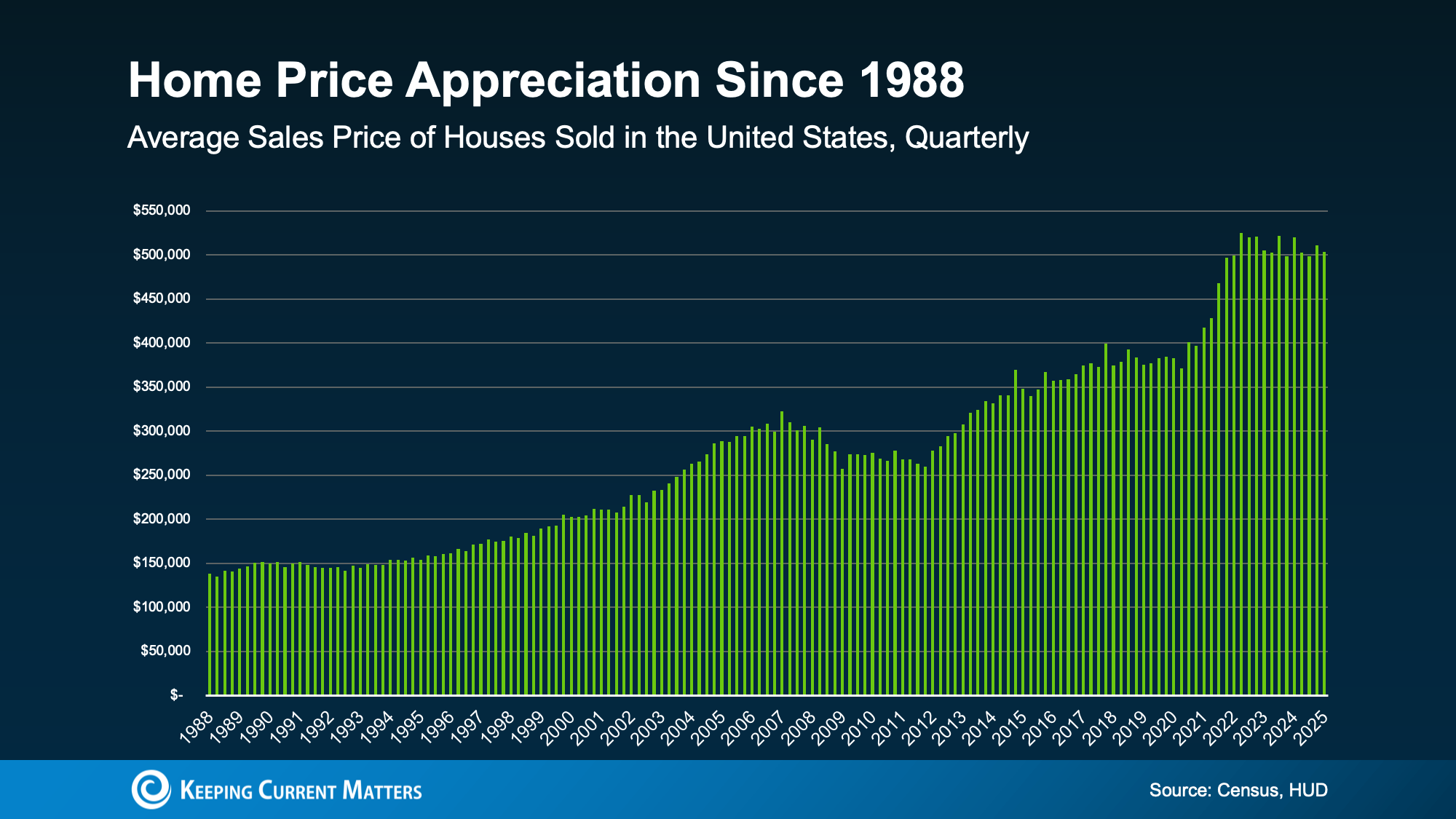
Why? Home prices typically rise over time, which means the longer you wait, the more expensive it is to buy. And even in some markets where home prices are softening today, the overall long-term trend speaks for itself (see graph below):

a graph of a price of houses sold in the united statesAnd as home values rise, so does your equity when you’re a homeowner. That’s the difference between what your home is worth and what you owe. So, with every mortgage payment, that equity grows. Over time, that becomes part of your net worth.

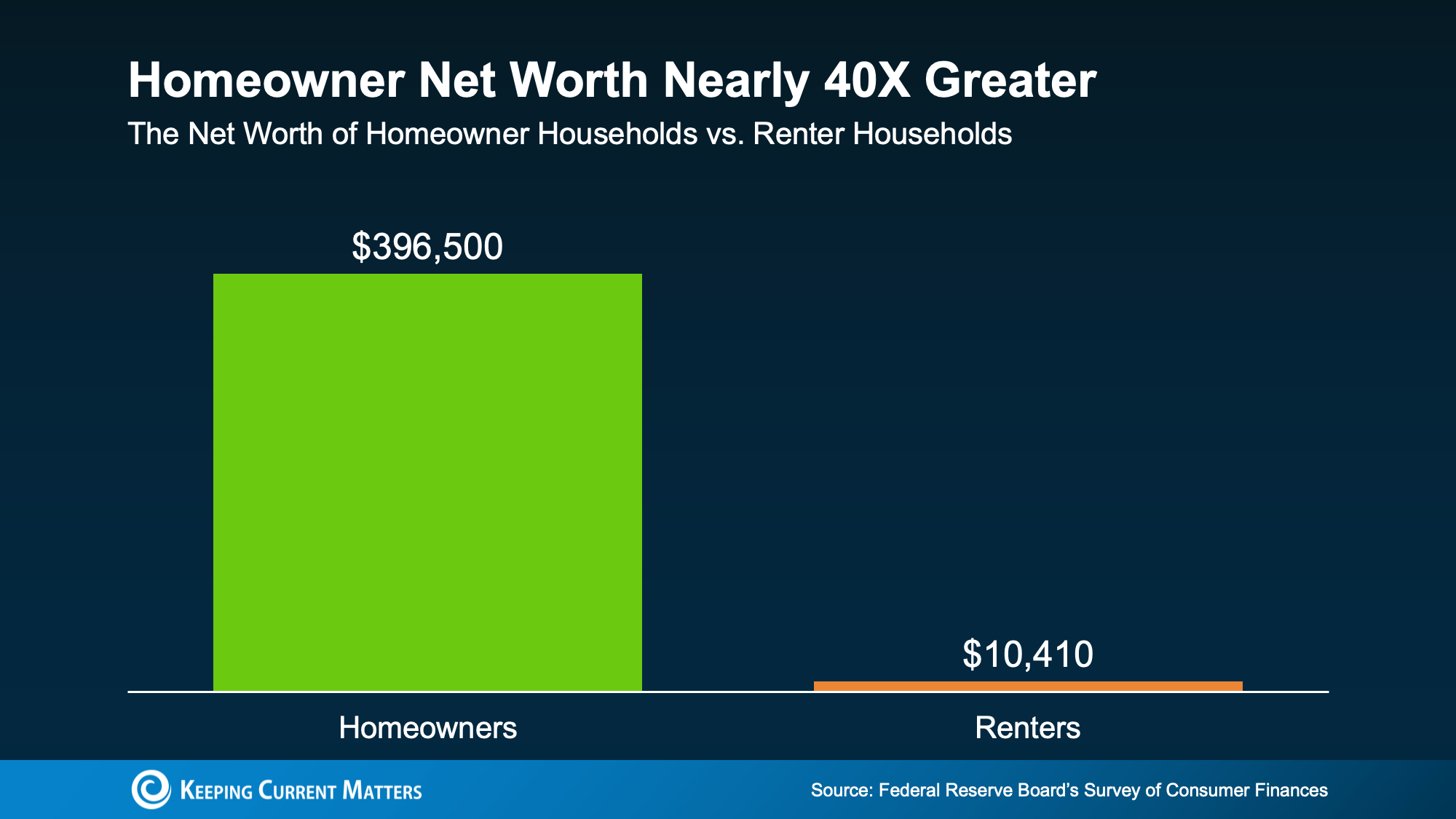
Today, the average homeowner’s net worth is nearly 40X greater than that of a renter. That’s a shocking difference, and the dollars in the visual below don’t lie (see graph below):

a green rectangle with white textAnd it’s one of the big reasons why Forbes says:

“While renting might seem like [the] less stressful option . . . owning a home is still a cornerstone of the American dream and a proven strategy for building long-term wealth.”

The Biggest Downside of Renting

So, short-term, why does renting feel like a simpler choice? Lower monthly payments, less responsibility, no strings attached. But long-term? It can sting.

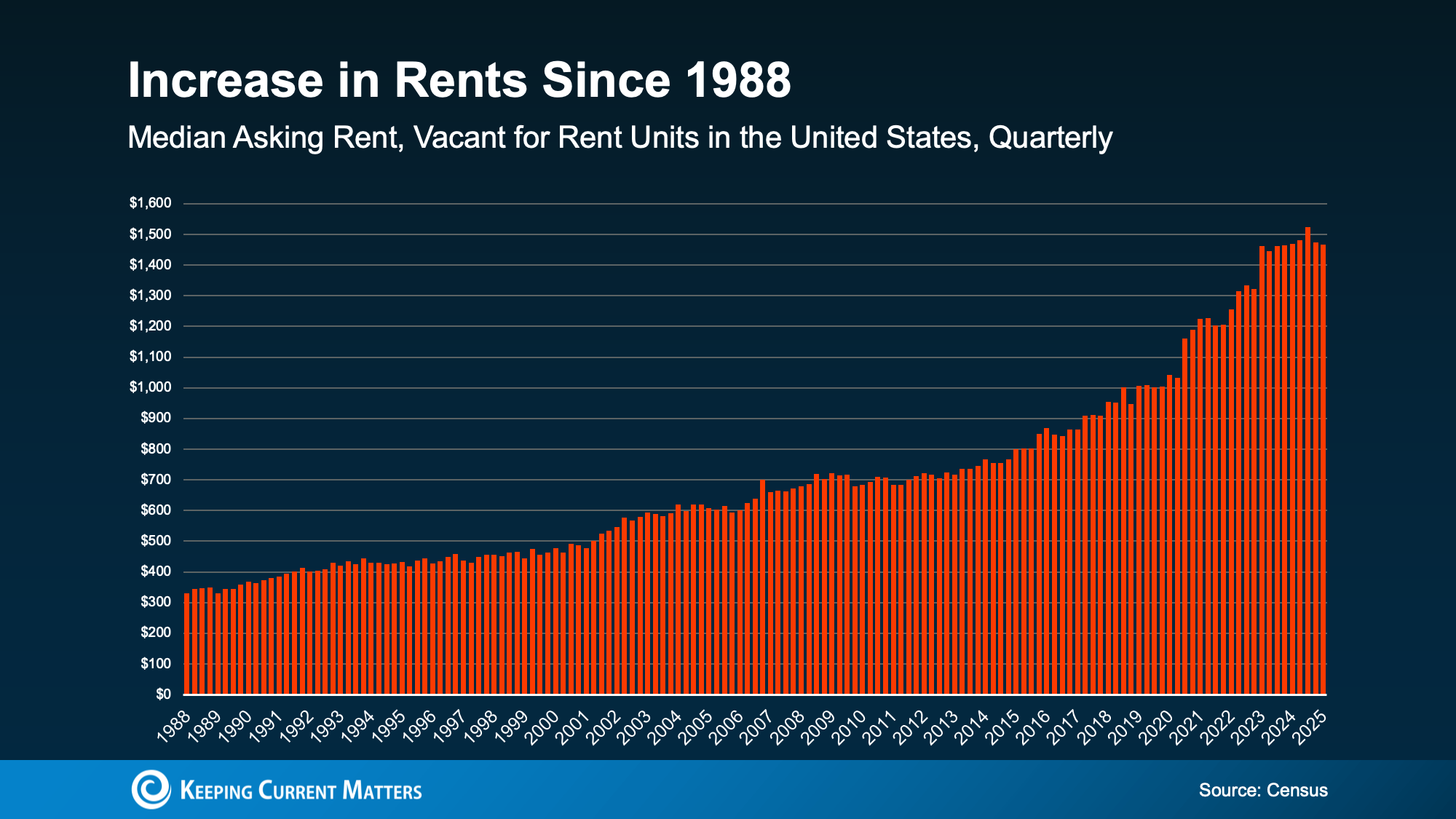
For decades, while home prices have been rising, rent has gone up too. And while rent has held rather steady more recently, history shows the overall trend is up and to the right. That makes saving for a home more complicated than ever (see graph below):

a graph of a number of peopleThat kind of financial uncertainty has a real impact. In the same Bank of America survey, 72% of potential buyers said they worry rising rent could affect their current and long-term finances.

Because rent doesn’t build wealth. It doesn’t come back to you later. It pays your landlord’s mortgage – not yours.

So, whether you rent or own, you’re paying a mortgage. The question is: whose mortgage do you want to pay?

Renting vs. Buying: What Really Matters

Think of it this way. Renting means your money is gone once you pay it. Owning means your payment builds equity – like a savings account you can live in. Sure, buying comes with responsibility. But it also comes with the kind of reward that grows over time. And that’s why you need a solid plan to get there.

As Joel Berner, Senior Economist at Realtor.com, explains:

“Households working on their budget will find it much easier to continue to rent than to go through the expenses of homeownership. However, they need to consider the equity and generational wealth they can build up by owning a home that they can’t by renting it. In the long run, buying a home may be a better investment even if the short-run costs seem prohibitive.”

Bottom Line

Renting may feel more do-able today. But over time, it could cost you more – without helping you build anything for your future.

If homeownership feels out of reach today, you’re not alone. And the first step toward getting out of the rental trap is to set a plan. Connect with an agent to set your specific goals and explore your options – so you’re ready when the time is right.

Source: keepingcurrentmatters.com ~ Image: Canva  Pro

Property Insurance vs. Home Insurance

Property Insurance vs. Home Insurance

Property insurance vs. home insurance. While it’s something many first-time homeowners debate, it’s actually not an either or question. That’s because property insurance is part of your homeowners insurance policy.

What is property insurance?

Property insurance is a broad term within the insurance industry. It is used to describe all those protections that cover a homeowner’s possessions—things like your home, car, motorcycle or personal items. Whether you live in a house, apartment or condo, you need property insurance.

Casualty insurance

To better understand property insurance, it’s important to understand another broad industry term: casualty insurance. It’s quite different from property insurance in that it provides you with liability coverage. It helps protect you if you’re found legally responsible for an accident that causes injuries to others or if you damage another person’s property.

Businesses also need to have casualty insurance. For example, if someone comes into your shop and they slip and fall, your business would be covered by a commercial general liability policy.

Together, these two broad areas of insurance are commonly referred to as P&C, which is short for property and casualty. You may have heard that term before.

Mortgage insurance

While we’re discussing what property insurance isn’t, let’s take a quick look at mortgage insurance. A mortgage insurance policy protects your mortgage lender if you’re unable to repay your loan. The cost of mortgage insurance is usually included in your mortgage payment.

It’s important to remember that mortgage insurance is completely separate from property insurance. Mortgage insurance doesn’t cover you, your home or your possessions in any way—just your bank.

What is home insurance?

Homeowners insurance is a more specific term than property and casualty insurance. It provides you with financial protection in case your home or personal possessions are damaged by a destructive event, such as a fire, wind or theft. Here is a list of the coverages that make up a standard homeowners insurance policy:

  • Dwelling  Also known as Coverage A, Dwelling protects against damages to the physical structure of the home. For that reason, it is the coverage used to repair or rebuild a home if it’s damaged by a fire, storm or some other event covered by your policy.
  • Other Structures – Also known as Coverage B, Other Structures covers structures on your property that are detached from the main house. Examples include garages, fences and sheds. Typically, your Other Structures coverage level is usually 10% of the Dwelling coverage.
  • Personal Property – Also known as Coverage C, Personal Property covers the items inside your home. Televisions, computers, furniture, clothing and some jewelry are all examples of personal possessions protected by this coverage.
  • Loss of Use – Also known as Coverage D, Loss of Use protects you if you’re forced to leave your home during repairs. It reimburses you for temporary lodging, meals and other related expenses. This coverage is usually 20% of your Dwelling coverage.
  • Personal Liability – Also known as Coverage E, Personal Liability provides protection if you are found responsible for property damage or injuries to others. It can help pay for legal expenses, medical bills and other costs.
  • Medical Payments – Also known as Coverage F, Medical Payments protects you if a guest is injured on your property. It takes care of the medical bills whether you were found responsible for their injuries or not.

What else do I need?

For many homeowners, a standard home insurance policy is more than enough coverage. However, you still may want additional protection. Flood insurance, earthquake insurance and umbrella insurance are all extra layers of protection to consider.

Flood insurance

A standard home insurance policy does not cover damage caused by flood. For that level of protection, you will need to purchase a separate flood insurance policy.

Flood insurance protects your home and belongings from damage caused by rising water due to flooding. This can be from heavy rain, melting snow or coastal storm surges, among other causes. By comparison, a standard home insurance policy only covers interior water damage. Examples include a burst pipe or water coming through the roof after a prolonged rainstorm.

Earthquake insurance

Similar to flood insurance, earthquake insurance is also a separate policy from your homeowners policy. If an earthquake strikes, it will cover repairs to your home, damage to your personal property, the cost to remove debris and any extra living expenses you might incur while your home is being repaired or rebuilt. Needless to say, you should strongly consider buying earthquake insurance if you live in an area that is prone to earthquakes.

Umbrella insurance

Umbrella insurance is a separate policy that increases your liability limits. This additional financial protection will help you if something unexpected happens. For example, if someone gets injured on your property or you cause damage to someone else’s property, umbrella insurance will protect you.

How do I insure valuable items?

Highly valuable items, like jewelry, furs and collectibles are only protected by Personal Property coverage up to a certain dollar limit. If you want to purchase more coverage, you can either schedule each item individually or buy a broader blanket coverage.

Scheduled personal property

The best way to protect valuable items such as jewelry or collectibles is to individually schedule each item. This requires you to tell the insurance company up front about each individual item and what you paid for it.

Let’s say you own a lot of expensive jewelry. It would be in your best interest to schedule each piece ahead of time. This way, if they’re damaged in a fire, your carrier already knows the pieces of jewelry you own, the years they were bought and so forth. This will make the claim settlement process go a lot more smoothly.

Blanket coverage

Blanket coverage is an endorsement that covers multiple pieces of property from the same category, such as jewelry, fine art or silverware. With this type of coverage, you don’t need to provide detail on each piece of property up front. For example, you could simply tell your carrier, “I want $10,000 of blanket jewelry coverage.”

While this type of coverage may be easier to purchase up front, the claim settlement process is usually slower if there’s a loss. That’s because your insurance carrier will ask you to prove that you had those items to begin with.

Source: plymouthrock.com ~ Image: Canva Pro

What Is Escrow? How It Keeps Homebuyers and Sellers Safe

How Escrow Keeps Homebuyers and Sellers Safe

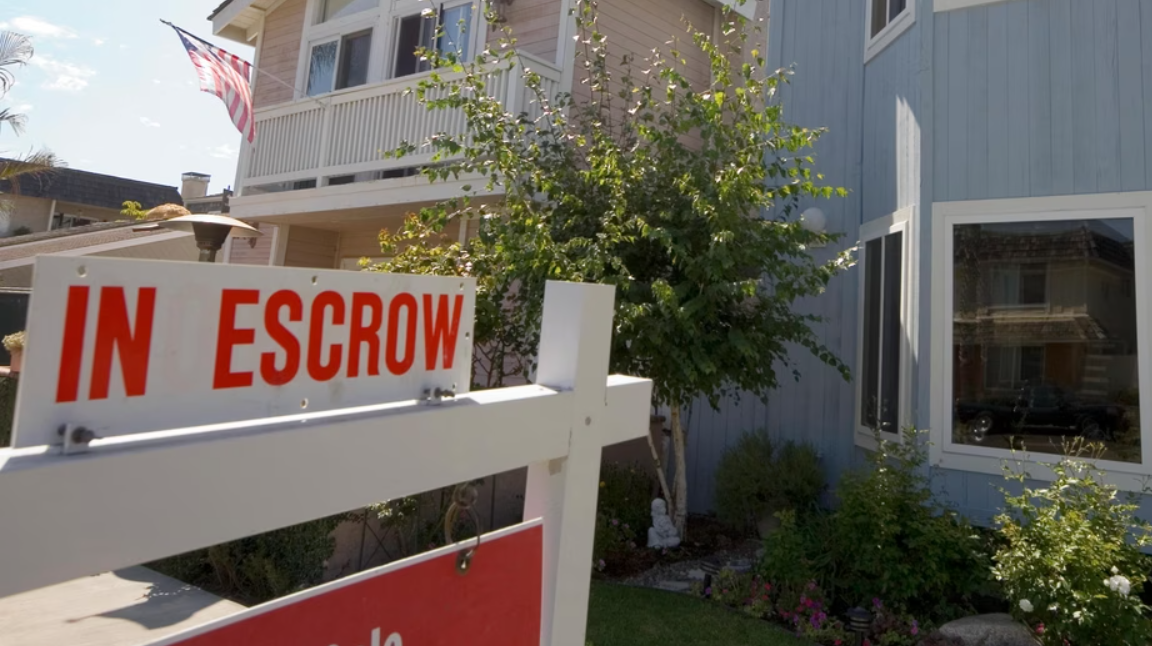
An escrow account is a secure holding area for money and documents during a real estate transaction. It protects buyerssellers, and lenders by ensuring no funds or titles change hands until all terms of the sale are met.

Escrow might sound complicated, but it’s one of the most important safeguards during the homebuying process.

Here’s a breakdown of how escrow works, who manages it, and how it protects both sides of the deal.

What is escrow in real estate?

In real estate, escrow is a legal arrangement where a neutral third party (usually an escrow officer or company) holds important items until the deal officially closes. These items can include the earnest money deposit, the signed purchase agreement, and other transaction documents.

The escrow process ensures that neither the buyer nor the seller is at risk of losing money or ownership if the other party doesn’t fulfill their part of the contract.

How escrow works during a home sale

The escrow agent is often someone from the real estate closing company, an attorney, or a title search company agent (customs vary by state), says Andy Prasky, a real estate professional with Re/Max Advantage Plus in Twin Cities.

Your agent will

  • Hold the buyer’s earnest money deposit in a secure escrow account

  • Collect documents from both parties, such as disclosures and inspection reports

  • Ensure all contract conditions are met (e.g., home inspection, loan approval)

  • Disburse funds and finalize the sale once all contingencies are cleared

Once all conditions are met and the transaction is finalized, the escrow officer will record the title transfer, release the funds to the seller, and the buyer will receive ownership of the home.

What does escrow cost?

Escrow fees typically range from 1% to 2% of the home’s purchase price, but the total cost can vary based on location and the complexity of the transaction.

Who pays the escrow fee—the buyer, the seller, or both—depends on your purchase agreement and local customs.

What is earnest money, and how is it used?

Earnest money—also known as an escrow deposit—is a dollar amount buyers put into an escrow account after a seller accepts their offer. The escrow company holds the money in an escrow account for the duration of the transaction.

Another way to think of it is as a “good-faith” deposit into an escrow account, which will compensate the seller if the buyer breaches the contract and fails to close.

Can you borrow earnest money from a lender?

Most homebuyers come up with cash for escrow and deposit it into the escrow account from their own funds. The payment amount is small compared with the cost of the home and the loan, and the homebuyers might not even have a mortgage lender yet when they make an offer on a home.

However, earnest money can be borrowed from your lender, but certain rules apply. First-time buyers are most likely to need to go to their mortgage lender to make this escrow account deposit. Your lender will ultimately count the deposit toward closing costs and the down payment on the house.

How escrow protects buyers and sellers

Escrow might seem like a pain, but here’s how it can work in your favor.

For homebuyers

Let’s say, for example, the buyer had a home inspection contingency and discovered that the roof needed repairs. The seller agrees to fix the roof. However, during the buyer’s final walk-through, she finds that the roof hasn’t been repaired as expected. In this case, the seller won’t see a dime of the buyer’s money until the roof is fixed. Talk about a nice safeguard!

For home sellers

Sellers benefit from escrow, too. Let’s say the buyers get cold feet at the last minute and bail on the transaction. This might be disappointing to the seller, but at the very least, buyers have typically ponied up a sizable chunk of change for their earnest money deposit. This money, often totaling 1% to 2% of the purchase price of a home, has been held in escrow. When buyers back out with no legitimate reason, they forfeit that money to the seller—a decent consolation for the sale’s failure and the expense of making mortgage payments and other expenses while the home was off the market.

What is an escrow account for a mortgage?

After you buy a home, your mortgage lender may set up an escrow account to pay future property-related expenses like the following:

Each month, a portion of your mortgage payment is deposited into this escrow account. When tax or insurance bills come due, your lender pays them directly using funds from that account.

If you overpay into escrow, you may get a refund check and see a reduction in your monthly payment. If costs increase, your lender might raise your mortgage payments to cover the difference.

Why escrow matters

Escrow is a safety net in real estate. It ensures that everyone involved (buyer, seller, and lender) has their interests protected, and that money and ownership change hands only when everything is in order.

Whether you’re navigating earnest money, closing costs, or a mortgage escrow account, understanding how this process works can save you stress—and money—during one of the most important financial decisions of your life.

Source: realtor.com ~ By Cathie Ericson ~ Image: Dale Taylor/iStock

Is a 15-or 30-Year Mortgage Right for You?

Is a 15- or 30-Year Mortgage Right for You?

You can build equity faster with a shorter term since more of your payment goes toward paying down principal.

Takeaways

    • When choosing a mortgage, two main options is a 30-year term and a 15-year term, though some lenders have additional options.
    • A longer-term mortgage will usually mean lower monthly payments, but a higher cost over the life of the loan; a shorter-term mortgage will reduce the overall loan cost and may have a lower interest rate, but will require higher monthly payments.
    • No matter your loan term, you can make additional payments toward the principal to save money and pay your mortgage off faster.

If you’re preparing to buy a home, you will need to look at not only mortgage interest rates, but also loan types and terms. Your mortgage term is how long you have to repay the loan, and most terms are 15 or 30 years.

Should you get a 15- or 30-year mortgage? If you can afford the payment on a 15-year mortgage, the long-term interest savings are great. But the lower monthly payment of a 30-year mortgage could offer you more flexibility if your financial situation changes.

Here, we break down the 15- vs. 30-year mortgage debate, including the pros and cons of each and how to decide between the two.

What Is the Difference Between a 15- and 30-Year Mortgage?

The primary difference between a 15- and 30-year mortgage is the length of time to pay off the loan.

A 15-year mortgage pays off your home in half the time of a 30-year loan and saves on interest overall. Borrowers typically qualify for lower interest rates for 15-year loans because the shorter term reduces risk for lenders.

The shorter term also means that more of your payment goes toward paying down principal, so you can build equity faster than with a 30-year mortgage. The trade-off is a higher monthly payment than a 30-year mortgage – at current rates, 20% or more. “The higher costs may not leave room for additional homeownership costs, such as renovations or unexpected repairs and maintenance,” says Shelby McDaniels, national director of business development at Chase Home Lending.

A 30-year loan’s lower monthly payment can provide more cushion in your budget. This can help make homeownership a possibility for more people.

30-Year Mortgage Pros and Cons

Pros

    • Lower monthly payments than a 15-year loan because they are stretched out over a longer time.
    • Easier to qualify for this loan with its smaller payments.
    • More room in your budget for other financial goals.

Cons

    • Higher interest rates because lenders consider a 30-year loan a greater risk than a 15-year loan.
    • Higher total interest paid.
    • Slower growth in home equity than a 15-year loan.

15-Year Mortgage Pros and Cons

Pros

    • Lower interest rates compared with 30-year loans because lenders take on less risk.
    • Lower total interest charges than a 30-year mortgage
    • Quicker loan payoff.
    • Faster equity growth, with more of your payment going toward principal.

Cons

    • Higher monthly payments compared with a 30-year loan.
    • You may not qualify for as big a loan because of the higher monthly payments.
    • Larger payments leave less flexibility for other financial goals, such as saving.

Crunching the Numbers: 15- vs. 30-Year Mortgage

Let’s say you need a $300,000 mortgage and qualify for a 15-year at 6.5% or a 30-year for 7.5%. Here’s how those costs would compare:

15-Year 30-Year Difference
Monthly Payment $2,613 $2,098 $516 savings per month if you choose a 30-year mortgage
Total Interest Paid After Full Term $170,398 $455,152 $284,754 savings in total if you choose a 15-year mortgage
Total Loan Amount After Full Term $470,398 $755,152

Alternatives to a Standard Mortgage Payoff

Exploring Other Mortgage Terms

If you’re on the fence between a 15-year and a 30-year loan, some lenders offer terms in the middle, such as a 20- or 25-year mortgage term. There are even some companies with 10- or 40-year terms if you’re looking for even more flexibility. Ask your mortgage professional to run the numbers to see which term option is best for you.

Paying Off Your 30-Year Mortgage in 15 Years

“There are tricks and hacks to dramatically reduce interest over the loan term,” says Erik Katz, president and founder of Rustic Country Real Estate in West Point, California. “If you take a 30-year loan and pay a few extra hundred a month, you may pay that mortgage down in 15 years anyway.”

Katz also suggests making an extra full payment at the end of each year if you can swing it to make a nice dent in the principal. You can also set up mortgage payments every two weeks, which results in an extra payment per year.

This way, if things ever get tight financially, you’re not locked into a higher payment. Just confirm that your lender doesn’t charge a prepayment penalty.

Refinancing

Starting off with a traditional 30-year term is best for many people. But if circumstances arise a few years into the mortgage that might allow you to refinance to a 15-year loan, such as a dramatic drop in interest rates, it could be worth exploring.

On the flip side, if you start out with a 15-year mortgage and the payments become difficult to manage, you can see if stretching it out into a longer loan term might help ease the financial pressure. Just be aware that doing so will mean paying more interest over the life of the loan.

15- vs. 30-Year Mortgage: How to Decide

Deciding between a 15- or 30-year mortgage comes down to finances and flexibility. Keep in mind that 30-year mortgages are far more common than 15-year loans for a reason: They are more affordable. The lower payment will give you more wiggle room, especially if your financial future is uncertain or your dream home wouldn’t be within reach with a 15-year mortgage.

On the other hand, a 15-year mortgage can offer savings if you have steady income to support your monthly payments and other expenses, including emergencies. “If the interest rate is a lot lower for the 15-year, that’s where I would advise to run the numbers,” says Katz.

Age may be a factor in your decision when weighing a 15- versus 30-year mortgage as well. “A 15-year mortgage could be a better option for those who are determined to pay off additional debts quickly, especially those who are preparing for an early retirement and want to minimize monthly payments,” says McDaniels.

A 40-year-old borrower, for example, could pay off a 15-year mortgage by age 55 while still owing on a 30-year mortgage through age 70.

If your ultimate goal is to save money, says Katz, “the name of the game is how fast can you get your house paid down.” Do the math and calculate your potential mortgage payment before you decide.

Source: money.usnews.com ~ By  ~ Image: CanvaPro

How to Sell Your Home While Living In It

How to Sell Your Home While Living In It

Buyers have all kinds of schedules and you may sometimes need to show your house at the last minute, depending on the kind of market where your home is listed.

Key Takeaways

    • Buyers often make decisions based on quick impressions, so sellers should develop a system for containing the mess of daily life before showing a home.
    • Declutter surfaces, closet space and cabinetry, and designate a space for children’s toys and pets.
    • Check with your real estate agent about the housing market in your area and how many showings you might expect.

Buying a house was one thing, but now you’re ready to upgrade, and you have to sell that house while you live in it. It’s a problem a lot of homeowners face, and although selling your home while you’re living in it can be a challenge, it’s not an impossible situation.

In fact, it’s common for sellers to live in their house until they sell it. But to do it successfully, you’ll need a plan to keep your living space tidy and ready to show to buyers.

Begin at the Beginning

Getting your house ready to show requires thinking like a buyer. No one expects you to live in a museum, but you should consider the impact of your belongings and lifestyle on potential buyers who may come in to look around.

“Everyone sees things differently,” says Désirée Ávila, real estate agent at Charles Rutenberg Realty Fort Lauderdale in Fort Lauderdale, Florida. “Some like to see it with the current furniture, while others prefer to see it empty so they can imagine their own furniture in it. That being said, a tip I always give clients is to declutter and depersonalize. Make the house look neutral, kind of like a hotel room.”

Although most people with families and busy schedules can live a bit of a chaotic life behind closed doors, it’s important to develop a system for containing all the mess that comes with being a person before you start showing your home. Buyers often make decisions based on their impressions, regardless of how great your house is under the necessary layer of lifestyle.

“Leaving mail on the counter, dishes in the sink, etc., makes the house look messy, smaller and oftentimes gives the impression the house is in worse shape than it is,” says Rick Albert, broker associate and investor with LAMERICA Real Estate in Los Angeles. “In residential real estate, there is a lot of emotion and feelings. It trumps logic more than people will admit.”

Just How Much Should You Tuck Away?

Realtors will tell you to declutter, but they rarely go into great detail about what that means. For someone who is naturally a little cluttery, it can be hard to know when you’ve reached the peak decluttered point.

“Try to reduce every surface (countertops, dressers, coffee tables) by a third,” says Ginger Lazovik, real estate agent with the Falk Ruvin Gallagher Team of Keller Williams in Milwaukee. “A good rule is three items per surface. Make sure that each surface is free of clutter and has no more than three essential or decorative items on it. Next, downsize the items in your closet and cabinetry by half. When buyers tour, they open closets and cabinets. Overstuffed cabinetry makes your home look like it does not have enough storage.”

But where do you put all that stuff you need to remove temporarily, but don’t want to get rid of permanently? A lot of sellers will automatically rent a storage unit, but real estate professionals say that’s not always a necessary expense if you have suitable storage space in your home and not too much decluttering to do.

“If sellers are able to neatly store their boxed items in the garage, basement, or extra room in the home, a storage unit may not be necessary,” says Jessica Fisher, real estate agent with RE/MAX Professionals in Cottage Grove, Minnesota. “Potential buyers are forgiving of boxes as long as they are neat, tidy, and not hindering their ability to examine the space.”

Enhance Your Home Before Listing

You may have heard that a home needs to be professionally staged to sell. This is not necessarily true. When you’re living in a home that you’re selling, people understand that you still live there. It’s still important to make your home seem very appealing.

“A well staged home can include the owner’s personal furniture,” Lazovik says. “Make sure that you do not have too many pieces of furniture in any particular room. Remove overstuffed chairs or anything that looks worn or damaged. Add layers like cozy pillows and fresh blankets and throw rugs to freshen up your space. Fresh flowers add color and a clean smell.”

The money you save on staging can pay off big time if you spend it on improving the first impressions of your home. After all, if people drive by, but aren’t interested enough to walk through the front door, you’ll never sell your house.

“The outside is the first impression a buyer will get of the house,” says Ávila. “As the old saying goes, you never get a second chance to make a good first impression. Investing in making the outside look inviting is essential, otherwise some buyers may choose to pass on the house altogether.”

Managing Showings While You Live in Your Home

Once your house is ready to show – really ready – it’s time to figure out how to keep it in show-ready condition. Buyers have all kinds of schedules and you may sometimes need to show your house at the last minute, depending on the kind of market where your home is listed.

“The kitchen and bathrooms must look impeccable. Always close the toilets and pull the shower curtain,” says Ávila. “Little Johnny might not like to make his bed but it is important that it is made if showings are expected. If the realtor gets a call that there is a cash buyer willing to close quickly, if the seller really wants to sell, they need to be ready to make an exception (to their showing schedule). If little Johnny’s bed is made, that is one less thing to scurry about doing to get the house ready for a showing not during the regular showing schedule.”

Other things to consider when preparing for showing are children’s toys and pets, both of which can make a house very hard to show if they’re not kept up with. If your child is too young to keep their toys completely picked up, or you can’t take the dog for a walk during every showing, there are options.

“What I have done is asked that kids’ toys be in a designated area, rather than all over the place,” says Albert. “For example, maybe the toys can all stay in the kid’s bedroom. For pets, gate off the side of the house and the pets can hang out there during the showing.”

Know What to Expect From Your Market

The idea that it’s a buyer’s market everywhere is fading, and there’s a lot of differentiation starting to take place. Understanding your market will help you set your expectations.

“For years, the country was moving in lockstep – it was a seller’s market everywhere,” says Lazovik. “Now, depending on where you live, it is either a buyer’s market, like Austin, a neutral market, or still a seller’s market, like Milwaukee.”

There are lots of different markets even within a single metro area, but your agent can give you some idea of what has happened with houses like yours and get you ready for what’s to come, whether that’s a chaotic cluster of showings that will feel like you’re in a war zone, or something a bit slower.

“The Twin Cities is currently experiencing what I call ‘A Tale of Two Markets,’” says Fisher. “Homes at $350K and below that are priced and presented well still have a chance at several showings and multiple offers. The move-up home market is much different. Sellers with homes priced above $350K can expect fewer showings and longer days on the market because this buyer pool typically has a home to sell first or is reluctant to give up their current lower mortgage rate. Although we don’t have the ability to see the future, we as agents try to prepare each seller for their specific situation.”

Source: realestate.usnews.com ~ By  ~ Image: Canva Pro

How Long Does It Take to Sell a House?

How long it takes to sell a house

How long it takes to sell a house depends on numerous factors. Here’s a look at the typical home-selling timeline.

Key Takeaways:

    • In February 2025, it took an average of 78.5 days to sell a home, from listing to closing.
    • The state of the market, the number of days on the market, the home’s price, its condition and its location can impact the selling timeline.
    • A listing agent can provide a market analysis of the home, discuss pricing strategies and explain the entire sale process.

Every homeowner’s home-selling journey is unique, even in terms of the time it takes to close the deal. In some cases, it could take just a matter of weeks from when it’s listed to closing, while others could sit on the market for months before going under contract. How long it takes to sell a house depends on your local market conditions, demand, the decisions you make and how you approach the selling process.

    • How long does it take to sell a house?
    • Factors that impact the house-selling timeline.
    • What is a typical selling timeline?

How Long Does It Take to Sell a House?

As of February 2025, the median days on market, or the number of days a home sat on the market before going under contract, was 54 days, according to real estate brokerage Redfin. Between Feb. 10 and March 30, the median number of days to close on a home after going under contract was 24.5 days. That totals 78.5 days on average from listing to closing; however, the sale of your home could be different. Every market and individual sale will vary in terms of the number of days on market and the time it takes to close.

Factors That Impact the House-Selling Timeline

While some houses may sell quickly, others can take longer. Once a house is listed, several factors can influence the speed of the sale. Here are some of the biggest factors to consider.

State of the Market

The law of supply and demand plays an important role in the real estate market on a national and local level. The state of the market is typically expressed as a buyer’s market or a seller’s market.

In a buyer’s market, there’s a bigger supply than there is demand for housing. It typically takes longer to sell in a buyer’s market. In a seller’s market, the demand exceeds the supply. Homes sell faster and sellers can command a higher asking price. A balanced market is one with four to six months of supply.

The Number of Days on the Market

Buyers tend to be more cautious of homes that have been on the market longer than others. “Buyers start to wonder what is wrong with the property and may pass it over for another property that hasn’t been available as long,” says Jessica Fisher, a licensed real estate agent in Minnesota and Wisconsin.

Pricing

Pricing your home too high can result in fewer offers or offers coming in considerably under the asking price. “In this market, homes are selling quickly if they are appropriately priced,” says Fisher. “Over-pricing presents challenges, including the stigma that comes with a home being on the market for any length of time.”

Condition of the Home

Potential buyers may overlook a home that needs extensive repairs. This could lengthen the time a house sits on the market. Uncovering problems with the home could also lead to additional negotiations and concessions that may impact the selling timeline.

Location

Location is key in how long it takes to sell a house and the property’s perceived value. If the house is in a highly desirable location, then it could sell quickly. If it’s located in an undesirable neighborhood, it could take longer.

The House-Selling Timeline

There are several steps to the home-selling process. Here is the typical timeline and how long each step usually takes:

Hire a Real Estate Agent

If you’d rather not spend the time and effort selling the home yourself, a real estate agent can help you through every part of the home sale.

“The first thing a homeowner should do is contact a trusted Realtor,” says Fisher. “A Realtor will be able to give the homeowner a clear picture of what’s happening in the local market and will also be able to provide a market analysis of the home, discuss pricing strategies and explain the sale process from start to finish.”

It’s also important to compare and interview agents in your area. “Sellers should hire an agent that honestly communicates with them about the market value of their home, the process of selling and what to expect. You want an agent to tell you the good, the bad and the ugly no matter what happens,” Fisher says.

Prepare the House For Sale

Unless you decide to sell your house as is, you need to prepare it to be listed on the market and shown to potential buyers. The length of time it takes to prepare the home will depend on how much maintenance and work the owner has already put into it.

According to the Bright MLS survey conducted in December 2024, more than half of buyers (56.1%) said that it was “very important” to buy a move-in-ready home over one that requires any updating. Putting in the extra effort to prepare your home makes it more marketable. Not only can you ask for a higher price, but it could also mean a faster sale.

List and Show the Property

Once everything is prepped, it’s time to price your home and list it on the market. After your home is listed, your real estate agent can schedule showings and greet potential buyers when they visit the property.

Although the average home sits on the market for about 54 days before going under contract, it could take more time or less before you accept an offer. The days on market can also depend on when you list your home. Research shows that November, December, January and February are the slowest months throughout the year and may even be less profitable.

Accept an Offer

After an offer is received, the response time may depend on the contract. Some contracts set offer time limits – 24, 48 or 72 hours – to dictate how long each party has to respond. Once it expires, the contract is void and a new offer must be submitted.

If there’s no contractual time limit, most agents, buyers and sellers follow common courtesy to respond within a few days after receiving an offer or counteroffer.

Appraisal and Inspection

After accepting an offer, the buyer’s mortgage lender may require an appraisal of the property to determine the fair market value. How long the appraisal process takes depends on the complexity of the appraisal as well as the appraiser’s schedule and workload. This can take anywhere from a few days to a few weeks.

An inspection may also be required before closing and usually takes place within seven to 10 days after an offer is accepted. This typically takes a few hours and then a day or two to write the report; however, this also depends on the size and condition of the property.

Negotiations

If the contract contains an appraisal or inspection contingency, the potential buyer can negotiate repairs or walk away from the deal if there are any problems.

According to the National Association of Realtors’ February 2025 Realtors Confidence Index Survey, 13% of contracts had a delayed settlement within the past three months. Of those delayed contracts, 7% were delayed due to appraisal issues.

Closing

At closing, the buyer and seller will be able to review and sign the closing documents. Redfin estimates that the median number of days to close on a home after going under contract was a little over 24 days. However, the length of time it takes to get to the closing table depends on the buyer’s mortgage lender, loan type and the current housing market.

Source: realestate.usnews.com ~ By: ~ Image: Canva Pro

Should You Buy a House With Cash?

Should You Buy a House With Cash?

Before you go all-in with your money, consider these caveats for buying a home with cash.

If you have enough money saved and the purchase won’t drain your savings, a cash purchase could be a good idea.

Key Takeaways:

  • Most people finance a new home, but anywhere from a quarter to a third of homebuyers pay in cash.
  • With high interest rates, buying a house with cash makes more sense now than it did a few years ago.
  • A mortgage is probably a better option if you can’t pay cash without draining your savings.

If high interest rates have you dreaming about buying a house with cash, you aren’t alone. Although this is a growing trend, most people still finance their homes. According to the National Association of Realtors’ 2024 Profile of Home Buyers and Sellers, 26% of homeowners paid for their home in cash last year, an all-time high. That still means 74% of homeowners went the traditional route of taking out a mortgage.

If you think you can swing a cash purchase, should you? Here’s what you should consider when contemplating buying a house with cash.

The Pros: Why Buying a House With Cash Is a Great Idea

You Own the House Right Away

This is obviously one of the best things about buying a house with cash. You own it, right off the bat. You have no mortgage payment. Life is good. As Lindsey Harn, a real estate agent with Christie’s International Real Estate in San Luis Obispo, California, says: “You own the home, free and clear.”

By skipping the mortgage now, you can rest assured that any increase in value on a property directly benefits you when it comes time to sell. With no mortgage to pay off, 100% of the profits from the sale go into your wallet, making it easy to purchase another home with cash or finance a larger purchase with plenty of cash on hand.

You’ll Save a Lot of Money

In January 2021, mortgage interest rates were 2.65%, and by October 2023, they were 7.79%. More recently, mortgage rates have hovered just under 7%.

When interest rates were historically low, borrowing was cheap. But now, “with current mortgage rates around 7%, mortgages have become less attractive,” says Jay Zigmont, a certified financial planner and CEO of Childfree Wealth, a life and financial planning firm in Mount Juliet, Tennessee.

“If you buy a house with a mortgage and invest your cash in the market, on average you are unlikely to beat a 7% return after taxes,” Zigmont says. He says homeowners who can skip a mortgage are essentially getting “a risk-free, tax-free return of the interest.”

He adds: “If I could invest my money and get a guaranteed 7% tax-free return, I’d do that all day.”

It’s also important to remember that by financing, you take on additional costs with loan origination fees and the interest paid over time, so the net cost of buying your home is less when paid for in cash.

By paying cash, you won’t have to make monthly payments to a lender, and when the house increases in value, that directly boosts your personal wealth.

Sellers Love All-Cash Offers

Especially if you’re looking to buy an in-demand house getting a lot of interest, an all-cash offer can provide the needed leg up to get the seller to consider your offer more seriously than others. You may not even be the highest bidder, but the seller knows a cash offer will make the closing process easier.

“I’ve had sellers take cash offers over higher financed offers because, for them, it meant a guaranteed, problem-free closing,” says Brett Johnson, a real estate investor, licensed real estate agent and owner of New Era Home Buyers in Denver.

Generally, if you’re competing against another buyer, an all-cash offer puts you in a stronger position to negotiate, Johnson says. “Cash offers are appealing for sellers because they remove financing risk and provide more certainty of close,” he says.

Harn agrees. “It’s typically considered an easier transaction, so if you are competing with multiple offers, the seller may be more likely to take your cash offer as a sure thing, versus an offer contingent upon the buyer obtaining a loan and getting funding,” she says.

Cash Speeds Up the Closing Process

Part of the attractiveness of your all-cash offer is the elimination of the waiting period often imposed by mortgage lenders, filled with due diligence and underwriting to receive and approve the loan.

With a cash offer, you have the freedom to choose which aspects of the due diligence process are most important, rather than those that are required by a lender. For example, you could choose to forgo an appraisal while still having the inspection done.

While your speedier homebuyer timeline can be a powerful tool in negotiations for a purchase, don’t get carried away by neglecting aspects of due diligence that could reveal serious problems with the property in question.

“You can usually close sooner,” says Rose Krieger, a Spokane, Washington-based senior home loan specialist with Churchill Mortgage. “Instead of following the schedule set by a lender, items like the home inspection and appraisal can be completed at your discretion.”

You’re doing this on your own timetable and not a lender’s. That can smooth the process for you and the seller.

In some areas of the country that have been battered by climate change, you may find homes for sale that are uninsurable, Zigmont says. “If they are uninsurable because of previous claims, the only option is to buy it with cash. We are likely to see an increase in uninsurable homes in areas like Florida and California,” Zigmont says.

Whether you really want to pay cash for a house you can’t insure, however, is something to consider.

The Cons: Reasons Not to Buy a House With Cash

You May Be More Prone to Making Mistakes

It may sound freeing to hear you don’t have to get your house appraised or looked over by a home inspector or get homeowners insurance, but that doesn’t mean you shouldn’t do those things.

“While a home inspection and appraisal are not necessary with a cash purchase, it is still recommended to have both of them done,” Krieger says. She also says cash buyers need to have a full picture of the true value of the home and any issues you might inherit.

“The biggest mistake cash buyers make is assuming they don’t need due diligence,” Johnson says. “Just because there are no lender requirements, don’t forgo property inspections or title research. I’ve witnessed buyers rush into deals without checking liens, zoning issues or structural problems, only to face costly surprises later.”

You Could Be House Rich and Cash Poor

“Another mistake individuals make is putting too much equity into a house and not retaining enough liquidity,” Johnson says. “Real estate isn’t liquid, and I’ve seen investors who regretted not retaining enough working capital for when unexpected expenses came up.”

It’s not wise to purchase a home with cash if you have just enough to pay for it. It’s a good idea to maintain an emergency fund that will sustain you for at least a few months if you were to lose your income – covering things like car maintenance, unexpected medical costs and your regular grocery and utility costs for up to six months. You’ll also want to have cash on hand for any number of unexpected house needs, from a new roof to a furnace that’s on its last legs.

“While owning a home free and clear is great, if you have to withdraw from your retirement or sell stocks and pay taxes, getting a small loan may be better than creating a tax implication for yourself,” Harn says.

In general, after you pay for a house, you need to think about a few other future expenses that may be on the agenda:

  • Furnishing and maintaining your home. If you just bought a house with cash, you probably have enough money to buy living room furniture, a bedroom set, a lawn mower or whatever you’re going to need. Presumably, with no mortgage payment, you’ll have money available every month to go toward stocking your pantry and updating your wardrobe, but think about whether such a significant cash outlay will hurt your quality of life.
  • Do you have other significant expenses coming up? If you have children to put through college soon, a wedding to pay for or other expenses coming up, like buying a new car, it could be better to put down a sizable downpayment, allocate some of the cash for upcoming expenses and borrow the rest.
  • Closing costs. “When paying with cash, there are still closing costs associated with the purchase via title and closing fees,” Krieger says. “It’s also critical to remember that you will be responsible for making your homeowner’s insurance and property tax payments on your own versus having an escrow set up for you by a lender.”

Should You Buy a House With Cash?

It depends. Everybody’s financial situation is different. But if you have enough money saved to purchase a house outright and the purchase won’t drain your savings, a cash purchase could be a good idea. It may be worth your time to schedule a meeting with a financial advisor to help you run through your own personal pros and cons.

As Johnson puts it, “A cash purchase can be a wonderful tool, but use the same amount of caution on a cash purchase as on a purchase with financing.”

Source: realestate.usnews.com ~ By:  ~ Image: Canva Pro

What You Need To Know About Homeowner’s Insurance

What You Need To Know About Homeowner’s Insurance

Homeowner’s insurance is a must-have to protect what’s probably your biggest investment – your home. And while you never want to think about worst-case scenarios, the right coverage is basically your safety net if something goes wrong. Here’s how it helps you.

  • Covers Repairs and Rebuilding Costs: If your home is damaged by fire, storms, or other covered events, your policy helps pay for repairs or even a full rebuild.
  • Protects Your Belongings: Many policies can also cover personal items like furniture, electronics, and clothing if they’re stolen or damaged.
  • Provides Liability Coverage: If someone gets injured on your property, homeowner’s insurance can help cover medical bills or legal expenses.

In the simplest sense, it gives you peace of mind. Knowing you have protection against unexpected events helps you worry less. And with such a big purchase, having that reassurance is a big deal.

And while your first insurance payment will be wrapped into your closing costs, you’ll want this to be a part of your budget beyond closing day too. That’s because it’s a recurring expense you’ll have once you get the keys to your home.

Here’s what you need to know to help you budget for this important part of homeownership today.

Costs and Claims Are Rising

In recent years, insurance costs have been climbing. According to Insurance.com, there are four big reasons behind the jump in premiums:

  • More severe weather events and wildfires are leading to higher claims.
  • Insurance companies are pulling out of high-risk areas, reducing options for homeowners in some states.
  • Past rate increases haven’t kept up with the rise in claims.
  • The cost to rebuild or repair homes has gone up due to higher material and labor costs.

Basically, disasters are happening more often, repairs cost more, and insurers have to adjust their rates to keep up. Data from ICE Mortgage Technology helps paint the picture of how the average yearly premium has climbed over the last decade (see graph below):

What You Can Do About It

Homeowner’s insurance is a must to protect your home and your investment. But with costs rising, you’ll want to do your homework to balance the best coverage you can get at the best price possible.

Homeowner’s insurance rates vary widely based on location, provider, and coverage. Shop around and compare quotes before settling on a policy. And don’t forget to ask about discounts. Things like security systems or bundling with auto insurance could help lower your insurance costs.

Bottom Line

When you’re planning to buy a home, it’s important to look beyond just your mortgage payment. You’ll also want to budget for your homeowner’s insurance policy. It gives you a lot of protection against the unexpected. And while it’s true those costs are rising, there are things you can do to try to get the best price possible.

Source: keepingcurrentmatters.com