9 Relocation Questions to Ask Before You Uproot for Work and Sell the House

Relocation Questions
n average, employees who get a job offer that requires them to relocate have a mere 2 weeks to decide whether they want to formally accept the position. The timeline could be even shorter in hot job markets—employers are wary about candidates shopping their offers around to competitors for a better setup…so they turn up the pressure.Regardless, 14 days or less isn’t much time to think over such a big change. In addition to making a career shift, a job transfer means finding a new house, general physician, grocery store, and social circle. And as a homeowner, you can’t just break your lease and be on your way—you’ll have to sell the house (likely on a tight deadline).Whether you’re the type of person who makes pros and cons lists or just needs to talk things through, we’ve rounded up 10 critical job relocation questions to ask before you sell your house to uproot for work so you cover all your bases.

1. What are the financial implications of selling my house and buying one in a new location?

Before you make the decision to relocate, it’s a good idea to ballpark how much you’d pocket from selling your house, and figure out how far that money would stretch in a new location that may have a drastically different cost of living. Will you be going from a spacious single-family to a shack with shared walls in a more expensive city? Or could a relocation mean you’re finally able to trade up to a nicer place?

Don’t just guess… do the math. You can follow this quick step-by-step:

Find out the value of your home

Get your estimates

(Note that online home valuation tools can give you a decent home value average, but you should consult a top local real estate agent who can conduct a formal comparative market analysis before setting your list price.)

Ballpark your home sale proceeds.

Once you have an estimate for what your house would fetch on the market, subtract your outstanding mortgage payoff amount and the estimated costs of selling a house including agent commissions (5%-6% of the sale price), transfer fees, and home preparations and repairs—likely amounting to 7%-12% of your home’s value depending on its condition.

With that you’ll have a solid estimate of your home sale proceeds.

Calculate your cost of living and housing budget.

Calculating how far your new salary will cover your new cost of living is key to deciding on the size of your new home and your price range. “That’s one of the questions you want to answer: What kind of lifestyle changes are you going to be experiencing in reference to cost of living?” said Gene Darden, a Relocation Specialist.

For instance, Darden explains: a 4,000-square-foot house in the Birmingham, Alabama, market costs about $500,000…In Atlanta, the same size costs twice as much.

There are lots of cost of living calculators online to help you evaluate how far your dollars will stretch. Sperling’s Best Places, the company that provides statistical information on crime rates, climate, and other factors, provides a cost of living comparison that includes housing, food, utilities, transportation, health costs, and taxes.

Want to dig deeper? Bankrate’s Cost of Living Calculator starts with a salary comparison between cities, then itemizes for costs such as specific foods (ground beef, coffee, half-gallon of milk), gasoline, clothing items, services (dry cleaning, hair salon), clothing, and toiletries such as ibuprofen and toothpaste.

Based on your home sale proceeds estimate and new monthly salary, you can figure out how much house you can afford in your new city.

A couple of good rules of thumb:

2. How fast do I need to move?

Your job start date will affect your packing, cleaning, and prep time for your home sale, as well as how your real estate agent prices your home.

“If they come to me and say, ‘I want to put my house on the market in January but … my job doesn’t start until May 1st,’ that would be a different approach than putting your house on the market in January and the job starts February 1st,” said Darden.

According to an Allied survey of 3,500 respondents, 47% of people relocating for a job had thirty days or less to move. Such a tight timeline makes a traditional home sale logistically difficult and you might consider accepting a cash offer for a shorter closing.

Although most sellers choose to list on the open market to achieve the highest possible price point for their house, a cash offer provides simplicity and certainty, so it could be an attractive option to streamline your job transfer.

Need a No-Fuss Home Sale?

Find out what cash buyers are willing to pay for your home right now.

3. What benefits will my new job have and how do they compare to my current employer’s offerings?

Not everything can be compared by salary alone. Glassdoor’s Employment Confidence Survey noted that about 60% of people reported that benefits and perks were a major factor in considering whether to accept a job offer—even over a pay raise.

The Harvard Business Review reported that it had surveyed 2,000 workers ages 18 to 81 about 17 benefits they would weigh when deciding between a high-paying job and a lower-paying one with more perks.

The majority (88%) gave heavy or some consideration to a job with better health, dental, and vision insurance, as well as more flexible hours.

Other benefits that respondents said might influence their job choice included more vacation time, work-from-home options, student loan or tuition assistance, paid maternity or paternity leave, free gym membership, and free day-care services.

A graphic showing a breakdown of relocation challenges.
Source: (Allied)

4. Can I find a comparable community where I’m relocating?

Getting acclimated to a new community is the second most challenging part of relocating for a job behind finding a new home, according to Allied. If you have children, you’ll naturally have questions about schools in a new area, for instance.

While some companies provide suggestions from all personnel to new employees who are house hunting, ranging from neighborhood commute times to school district ratings, your real estate agent also can be a good resource.

“It’s not just selling their home but answering all those other questions: What is the school district? Where can I go that somewhat parallels where I am now?” Darden said.

5. How far will my new commute be?

According to CNBC, Americans are spending more time commuting to work: about 26 minutes each way compared with less than 22 minutes each way in 1990. Those extra minutes add up throughout the year to a whole work week (about 35 hours) in transit! So consider in your calculations, not just the price of gasoline but any benefits that might offset a long commute, such as flex time.

SmartAsset has a handy commute calculator you can use. Simply input your future home address, work address (plus any other addresses you’d like to compare) and it will give you an estimated commute time by car, public transportation, or foot.

6. Will my employer pay for me to visit the new city and scope it out first?

When you’re relocating to another city or state because of work, your employer might provide financial relief for your moving expenses.

“I would say probably that for at least 50% of my clients, the company picks up a lot of the moving expenses and other costs that are associated with selling their home,” Darden said.

Although Darden has known employers to pay for expenses only to help with the move itself, there are companies that provide other forms of compensation.

According to the Allied survey:

    • 20% of respondents said that their employer sponsored trips for a house search.
    • 21% of respondents received a lump sum to use as needed.
    • 22% received a “miscellaneous expense allowance,” either of which could be used to check out housing once you’ve accepted the job.

7. What moving expenses will my employer pay?

In general, the larger the company, the more likely you’ll have some financial assistance with your move. About 63% of the Allied respondents who had relocated worked for companies that offered relocation packages. Companies with 5,000 or more employees had this benefit in 77% of moves, but even about 71%-72% employers with 500 to 1,000 employees offered a relocation package.

8. What’s my tax liability?

The Internal Revenue Service won’t require you to pay taxes on up to $250,000 of capital gains from the sale of your home if you’re filing as an individual and you’ve used this as your primary residence for at least two of the past five years. (This exclusion bumps up to $500,000 for couples filing jointly.)

Even if you meet that exclusion, however, you may be responsible for municipality and state taxes, depending on the details of your move. Consult an accountant before you file to help you sort through these fees, as well as walk you through deductions you qualify for.

9. What coordination will I need to do between here and there?

Some employers contract with a relocation company that helps employees find and purchase housing in a new area. Darden has known clients who have had such a benefit, which picks a real estate agent in the new location. He’s also assisted people without access to this service by coordinating with another agent from his brokerage in their new hometown.

However your move is structured, you want effective communication. “You want to liaison with the Realtor where they’re going and help with that process,” he said.

Studies consistently show that moving is one of the most stressful events in life, whether you’re moving across town or across the country. But there are resources and professionals available to help take off the pressure by answering your most pressing questions.

“Even if you haven’t found the house yet, you get all the questions answered that you can,” Darden said, “because the more unknowns you remove from a situation, the less stressful it’s going to be.”

Source: homelight.com ~ By: Valerie Kalfrin ~ Image: Canva Pro

The Guide to Understanding Your Home Value

Understanding Home Value

Here’s a look at the process of calculating the value of your home and what it means for your home’s sale price.

You know how much you paid for your home, and you likely factor the work you’ve done and the memories you’ve made there into your idea of what it’s worth. But while your home may be your castle, your personal feelings toward the property and even how much you paid for it a few years ago play no part in the value of your home today.

In short, a house’s value is based on the amount the property would likely sell for if it went on the market.

Why Should You Know the Value of Your Home?

You should have a grasp of the value of your home in a variety of situations: if you’re getting ready to sell your house, looking to refinance your mortgage or buying a new homeowners insurance policy, for example.

For a better understanding of what your home’s value means, how it may change over time and what the impact may be if the housing market shifts significantly in your neighborhood, city or even the whole country, here’s our breakdown.

What Is the Value of My Home?

If your property value is based on what a buyer is willing to pay for it, all you have to do is find someone willing to pay as much as you think it’s worth, right?

Determining a home’s value is a bit more complicated. Keep in mind that buyers place no value on the good times you’ve spent there and might not consider your updated bathroom or in-ground swimming pool to be worth the same amount you paid for the upgrades.

And even if you find a buyer willing to pay $450,000 for your home, the value of your house isn’t necessarily $450,000. Ultimately, the financial backing in a deal determines the property’s value, and it’s most often a mortgage lender making the call.

Property valuation primarily takes into account recent sales of comparable properties in the area. Key identifying factors are the same square footage, number of bedrooms and lot size, among other details. Professionals who determine property values for a living compare all the details that make your house similar and different from those recent sales, and then calculate the value.

But when your property is unique – maybe it’s a triangular lot or a four-bedroom house in a neighborhood full of condos – determining the value can be more difficult.

The individual, group or tool appraising the property may also influence the outcome of the appraisal since they all appraise properties differently for a variety of reasons. Here’s a look at common appraisal scenarios.

Lender Appraiser

In the case of a property sale, the appraisal often happens once the property has gone under contract. The lender will hire an appraiser to complete a report on the property, getting all the details on the house and its history, as well as the details of similar real estate deals that have closed in the last six months or so.

If the appraiser comes back with a valuation below that $450,000 sale price you’ve agreed upon, the lender will likely state that it is willing to lend an amount equal to the property’s value as determined by the appraisal, but not more. If the appraisal comes in at $425,000, the buyer has the option to come up with the $25,000 difference or try to negotiate the price down.

Sellers are often open to negotiation at this point, knowing that a low appraisal likely means the house won’t sell for a higher price once it’s back on the market, though excessive interest in a property may be able to sway an appraiser.

Lindsay Katz, a real estate agent with Redfin in the Los Angeles area, says low inventory and high demand has made the Los Angeles market extremely competitive. In cases of multiple offers on a home that drive the price above its initial asking point, a higher value becomes easier to prove to an appraiser that the market value of the home has risen. “I don’t know how you can’t justify that price when 13 people agree,” Katz says.

Appraiser You’ve Hired

If you haven’t yet put your house on the market and are struggling to determine price, hiring an appraiser can help you get a realistic estimate.

Especially if you’re struggling to agree with your real estate agent on what the most likely sale price will be, bringing in a third party could provide additional context. The cost of a formal appraisal is about $350 on average, according to home services company Angi.

Online Home Value Estimator

Many real estate information sites offer more informal home appraisal tools that will give you a ballpark value for your home. You may have previously taken a look at U.S. News’ own home value estimator, Zillow’s Zestimate, realtor.com’s RealEstimate tool or explored the Federal Housing Finance Agency’s House Price Calculator.

It’s important to keep in mind that an online home value estimator is simply pulling from available information online and may not have all the facts that a professional appraiser would utilize in a valuation report. The online algorithms can catch many details, but they don’t necessarily have the ability to account for more localized factors, like the impact of severe storm damage or trends taking place in your city.

“There’s a lot of information out there,” says Danielle Hale, chief economist for realtor.com. “They don’t always agree, depending on how unique your home is or if there aren’t a lot of sales where your home is.”

Tax Assessor

Your home’s value also determines annual property taxes. In addition to examining the sale prices of similar houses that sold recently, a tax assessor looks at what the cost would be to build a similar house, whether you’ve done any recent improvements, if you earn income from the property and the cost of upkeep.

A property’s assessed value for tax purposes is often less than the appraised value – and that’s a good thing. The property taxes you pay annually are based on the assessed value, so the higher it is, the more you owe.

How Do Market Values Apply to My Home?

There are multiple ways to find out the current value of your house, but individual appraisals and assessments aren’t the only cases where you’ll hear about home values. In annual, quarterly or even monthly reports, home values are often discussed along with the rising cost of homeownership on a local, state and national level.

Depending on the source of information, reported values may be based on online estimator tools, listing prices for houses currently on the market or property value information from local assessors’ offices. These numbers are useful to discuss trends on a large scale, but they don’t always reflect the actual sale prices of real estate deals that closed in those time periods.

The details you get about rising values can be useful as you prepare to put your home on the market, buy your first house or learn more about economic forecasts, but don’t take national trends as indicators of what’s happening in your area.

The importance of trends in home values depends on the stage of homeownership you’re in or moving toward. Here’s what you should know:

For Buyers

As you’re preparing to start house hunting, keeping up on real estate market trends can be an excellent way to know what you’ll be facing. If values are climbing every month and year-over-year comparisons show fast growth – for example, 5% or more – those are signs that a lot of buyers are looking for houses at the same time as you. In mid-2021, home values were climbing at an incredibly fast pace, and the median sale price in the U.S. was seeing more than 20% year-over-year growth. Don’t expect this to repeat soon.

For Investors

Whether you’re looking to invest in a property for rental income or buy a fixer-upper for a quick turnaround, current market trends may influence your choice of purchase. In Los Angeles and many other parts of the country, more time spent at home during the pandemic caused many buyers to shift their focus when looking for a place to live. Instead of prioritizing proximity to shopping and nightlife, for example, “people renting or living in a condo are thinking they’d like to have a backyard, perhaps a pool,” Katz says.

But before you invest in a sprawling property with all the outdoor amenities, learn more about the market and its previous trends. You’ll also want to crunch the numbers to see if rent will be able to cover the mortgage and upkeep on an income property.

For Homeowners and Sellers

If you’re preparing your home for sale or just looking to learn more about your net worth, keep in mind that wider home value trends and reports have little impact on you.

Instead, keep a close eye on local reports; those that provide monthly or quarterly trends on your specific ZIP code can be a better reflection of what’s happening to your property value, Hale says.

Especially if you’re considering selling your home, a knowledgeable real estate agent could be your best source in understanding your property value. “You would want to reach out and talk to an agent and get a local expert’s assessment,” Hale says.

On the other hand, “if you’re not selling, a (positive) change in value still might help you feel wealthier,” says Hale, noting that a current valuation of your home may help you make future financial decisions.

How Can I Increase My Home’s Value?

Whether you’re planning to sell now or in a couple of years, or you’re simply looking to make your home as valuable as possible in the long term, you can potentially help increase its value with regular maintenance, renovations or even additions that could appeal to homebuyers.

Short Term

Many homeowners are motivated to add value to a property when they’re preparing to sell. It’s not impossible to add a couple of thousand dollars to the price tag with some simple remodeling projects that can make your home look fresh and appeal to buyers. Here are a few:

    • Fresh paint in neutral colors.
    • New landscaping.
    • Smart thermostat.
    • New or refinished cabinets.
    • New or well-maintained roof.
    • New or well-maintained furnace or air conditioning.

Maximizing value isn’t just about cosmetic fixes – it’s also about focusing on key areas like the roof and HVAC systems that would come up in a home inspection. Issues like leftover water damage on the ceiling from an old roof leak or a cracked window will show up in the home inspector’s report. If anything concerns the buyer too much, you may run the risk of the deal falling through.

Midterm

If you’re looking to make changes to your home so it’s on par with a different caliber of properties in your neighborhood, consider these larger construction projects:

    • Primary suite addition.
    • Guest bedroom add-on.
    • Finished basement.
    • Garage construction.
    • Complete kitchen renovation.
    • Bathroom addition.

These more extensive changes can be an excellent way to take your home to the next level, but only if other houses like this exist in the area. Adding a master suite and new garage to a neighborhood full of two-bedroom bungalows with street parking won’t make the property appraise much higher than the others. That’s because your house may no longer appeal to the typical buyer in that neighborhood.

Long Term

If you’re looking to increase your home’s value for the sake of your overall wealth, the best thing you can do is continue to pay off your mortgage and gain equity in the property. With proper upkeep and work to keep the home up to date, your home value will, on the whole, naturally increase over time.

Source: realestate.usnews.com  ~ By Devon Thorsby ~ Image: Canva Pro

California’s Guide to Solar Panels, Including Pricing and Incentives

Guide to Solar Panels

Going solar in California could be worth it even with the state’s new net metering rules.

California is a leader in the solar industry, with enough solar power installed statewide as of December to power 10.7 million homes. Solar panels may be a good option if you live in the Golden State and are interested in lowering your household carbon emissions while also saving on energy bills.

California’s average residential electricity rate is higher than the national average making Californians pay a higher traditional energy bill than residents in other states, according to SaveOnEnergy, CNET’s sister company.

On April 15, California’s new net metering regulations went into effect. Overall, they increase the incentives for going solar with a battery while reducing the payouts for solar without storage.

Meanwhile, the cost of residential solar panels has decreased by more than 69% in the last two decades, according to a Lawrence Berkeley National Laboratory report. Tax credits and rebates at the federal, state and local levels can help bring that cost down further. Whether you’re interested in helping the environment or lowering your energy bills, the amount you could save on solar panels in 2022 is higher than in previous years.

California solar panel costs

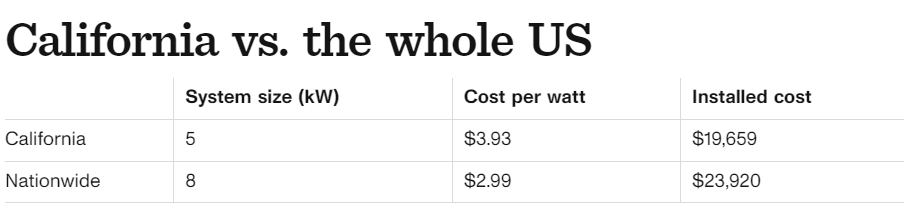
The cost of a home solar panel system will depend on the system size (i.e., the number of panels included), components like solar batteries and installation costs. California’s average solar panel system is smaller (and therefore cheaper) than the national average, even though the cost per watt is normally above the US average.

Because solar is so popular in California, there is also a high number of solar panel installers, which gives customers plenty of options to choose from when looking for the right solar company.

Here’s a breakdown of the average size and cost of solar panels in California and nationwide based on 2022 data from Findenergy.com and consulting firm Wood Mackenzie.

How to pay for solar panels in Californ

If you decide to invest in solar panels for your home, there are several financing options to make the purchase easier.

Cash: A big expensive project like solar panels requires a lot of cash. If you see solar power in your future consider saving money now. Regular contributions to a high-yield savings account can help pad your savings.

Solar loan: Many solar companies will offer third party financing. Shop around with different lenders, because your solar company’s third party choice might not have the best terms or interest rate.

Home equity loan or HELOC: You can also consider a home equity loan or line of credit,. These can save you on interest but your home is at risk if you fail to repay.

Mortgage: Another way to get the cash for solar panels is to refinance your mortgage. Fannie Mae’s HomeStyle energy mortgage is designed to fund energy efficiency projects.

California solar panel incentives and rebates

Even though the cost of solar panels has decreased in the last two decades, they’re still a substantial investment. But several solar tax credits and incentives make solar more affordable, especially in California. One key solar incentive, net metering, was reduced in a utility commission vote last year. When that change goes into effect April 15, it’s expected to increase a solar system’s payback period from six years to 10. California also introduced time of use rates, which could make installing backup batteries more profitable.

The residential clean energy credit (previously known as the investment tax credit) is a federal solar tax incentive offered in California that credits 30% of the cost of a solar system back to consumers who buy solar panels. This solar tax credit was increased and extended due to the Inflation Reduction Act, passed in August. There is no cap on the federal tax credit, so you can claim the entire 30% regardless of the size of the system.

You can apply for the residential clean energy credit by including IRS Form 5695 with your tax return. The IRS provides instructions on how to fill out this form, or the best tax software can take care of it for you. Your savings from the tax credit will be included in your tax refund or used to offset taxes you owe.

There are various state and local solar incentives available in California, too. You can find a more comprehensive list through the Database of State Incentives for Renewables and Efficiency. Here are just a few you should know.

California Solar Incentives

California solar panel companies

According to the Solar Energy Industry Association, nearly 2,000 solar companies operate across California. While this means there are plenty of California solar installers to choose from, it can also feel overwhelming to sort through your options.

We’ve compiled a list of solar panel companies that stand out in the industry. Here are a few California solar installers you can consider during your search.

ADT Solar

Formerly Sunpro Solar, ADT Solar operates throughout California and provides a variety of solar systems, including battery installations. ADT Solar says it prioritizes customer satisfaction and offers 25-year labor, power production and manufacturer warranties. The company also extends a price-match guarantee on installations.

ADT Solar does not offer solar leases or PPAs. It previously preferred to source its solar panels from LG, which left the industry in 2022. Since then, ADT Solar has confirmed it is committed to providing solar customers with a 25-year manufacturer warranty and will continue to extend a 25-year production guarantee from ADT.

Palmetto Solar

Palmetto is one of the largest solar companies in the country and offers home solar systems in California. With Palmetto, you can buy solar panels outright or sign a solar lease or PPA. The majority of Palmetto’s customers choose to buy their solar system to save the most money on energy bills over time.

Palmetto has operated in the solar industry since 2010 and says it’s committed to top-tier customer service. It offers a subscription called Palmetto Protect, which monitors the performance of a solar system and provides tiered levels of support if the solar panels are damaged or fail. Palmetto solar panels have an efficiency rating above 19.8%, a minimum 12-year product warranty, and a 25-year performance guarantee.

SunPower Solar

SunPower offers some of the most efficient residential solar panels and the best warranties on the market. With an efficiency rating of up to 22.8%, the SunPower Equinox solar panels outrank all competitors. The SunPower Equinox package includes solar panels from Maxeon, a manufacturer that worked with the company until 2020, and Enphase microinverters and mounting equipment.

SunPower operates across most California regions and aims to continue providing more accessible and affordable solar products. The company was founded in 1985 and offers some of the strongest warranties available, guaranteeing 92% production capacity for 25 years.

Sunrun

Sunrun is the largest solar company in the US and offers a strong lineup of solar products and warranties. Sunrun’s focus is on solar leases, which come with a different set of pros and cons, but can be a good option for consumers who aren’t able to purchase a solar system. While most of Sunrun’s customers lease their equipment, the company still offers the option to buy solar panels.

The company currently sources its solar panels from several manufacturers. For people who lease their system from Sunrun, the company provides “bumper-to-bumper” coverage on maintenance and monitoring. However, those looking to buy a system will rely on the manufacturer’s warranties. Sunrun does offer a 10-year quality warranty, which covers roof damage and installation issues.

Tesla Solar

Tesla became a big player in the solar market in 2016 when it purchased SolarCity, which significantly increased Tesla’s installation capacity. Between the solar panel branch of Tesla and the Tesla Solar Roof, Tesla is one of the most recognizable brands in the industry.

The price tag, efficiency rating and warranty terms will differ depending on the solar system you buy from Tesla. The Tesla Solar Roof comes with a 25-year product warranty and a performance warranty at 95% capacity after five years and 85% after 25 years. However, the Solar Roof has a much higher price tag than many competitors.

Meanwhile, Tesla solar panels are more affordable than the Solar Roof, and the quality remains high. Its solar panels are warranted at 85% capacity after 25 years and have an efficiency range between 19.3% to 20.6%. It is worth noting that some Tesla customers have reported issues with customer service.

Installation factors to keep in mind

Solar panels are a big investment, so it’s important to consider all elements that could impact whether they’re right for you. Some installation aspects to consider include:

  • The condition of your roof: The size, shape and slope of your roof can affect how much electricity a solar system generates. According to the Department of Energy, solar panels are most efficient on roofs with a slope between 15 and 40 degrees. The age and overall condition of your roof are also considerations. Older roofs or roofs needing maintenance should be replaced or repaired before solar panel installation.
  • HOA and neighborhood regulations: California law prohibits homeowner associations from banning solar panel installations, but there may still be specific requirements and approval processes in your neighborhood. Be sure to research the requirements for solar installation in your neighborhood ahead of time, so there are no issues down the road.
  • Insurance coverage: After installing solar panels, contact your homeowner’s insurance agency to add the panels to your policy. Most standard homeowner’s policies cover rooftop solar panels, but you’ll need to check with your agency for the specific details of your policy.
  • Your location: Solar panels are designed to work in all climates and areas that receive indirect sunlight. But they’ll be much more efficient when installed where they receive at least four hours of direct sunlight each day. If your home is in a cloudy region of California or gets shade coverage throughout the day, a solar panel system will not generate as much electricity as it would with direct sunlight.
  • Rentals: If you rent your home, you may not be allowed to install solar panels. You can check with your landlord or rental management company to confirm whether solar panels are allowed. If not, you can consider community solar programs as an alternative. These let you subscribe to electricity produced by solar panels at another location and receive a credit on your energy bills. The subscription fees are set at a lower rate than the value of these credits, so you come out ahead financially. In California, community solar programs are expected to grow quickly due to new regulations.

Source: cnet.com/home ~ By Caitlin Ritchie ~ Image: Canva Pro

Selling Your Home in 2023: 5 Rules to Help You Get Ahead of a Buyer’s Market

Selling Your Home

Two-thirds of Americans plan to sell, buy, or refinance homes in 2023.[1] But they’ll face a housing market that has changed dramatically in the past year – and will keep shifting.

A rapid slowdown started last summer as inflation and mortgage rates rose and potential buyers dropped out, ending the red-hot pandemic housing market. With homes taking longer to sell — and fewer buyers to compete with — the buyers who remain hold more of the cards.So, what does that mean for home sellers?With borrowing costs higher than they’ve been in several years, buyers are looking for bargains. They also have more time to shop.

Don’t expect bidding wars to drive up your price, for one. Instead, expect to negotiate and possibly offer concessions. And if your home needs some work, get ready to help with the costs or give a little on your list price.

That said, there are still ways for sellers to walk away from a home sale happy.

Here’s how to get ahead of a buyer’s market in 2023 — including what to do when you’re selling AND buying or selling and older home in need of repairs.

5 rules for selling your home in 2023

1. Spend wisely to fix up your home

Homes with the best presentation, condition, curb appeal and appearance will always command a premium. But that doesn’t mean you should jump into extensive renovations to prepare your home for sale.

Instead, focus on repairs and improvements that will help your home compete against comparable ones in your area. Make sure that you’ll regain at least what you put into your home through your sale prices. Make every dollar count, especially in a 2023 real estate market that will increasingly favor buyers.

Your improvements will depend on your home’s age and condition. Also, consider your time frame. How much time do you have before you plan to sell? Use your available time well, especially if you plan to save money. This is no time to sit back.

Give the highest priority to items that allow a good return on investment, especially low-cost but noticeable repairs and improvements. Here are a few items that can provide bang for your buck:

    • Repaint your home’s exterior and key interior rooms.
    • Landscape your yard and discard items you’ve been accumulating outside.
    • Declutter and deep-clean your entire home, area by area.
    • Fix leaky faucets, toilets, and showerheads.
    • Adjust and lubricate your windows, doors, cabinets and drawers.
    • Replace worn or damaged carpeting or flooring.
    • If you’re considering a bigger project due to the home’s condition, focus on the kitchen or bathrooms. They tend to have the highest return on investment.

Can you do some of the work yourself? Every dollar you save puts you in a better financial position for your home sale. For example, saving $5,000 on landscaping could enable you to offer a closing credit to seal a deal with your eventual buyer.

2. Manage your cash and credit well

Be careful about your finances, especially if you plan to buy a home after you sell your current one. Don’t take on unnecessary debt without a fairly good certainty of eventual payoff.

How will you pay for the repairs and improvements you are planning? If you have an existing home equity line of credit, or HELOC, that might be a good approach. However, if you’re planning to sell in 2023, taking out a new HELOC or cash-out refinance probably won’t make sense. You won’t recover your costs. If you have a longer time frame, you might find it will pay off, but keep in mind that interest rates are high. However, mortgage interest is tax-deductible, which could help in a longer time frame.

If you have enough cash on hand, that may be your best option. Just make sure you’re not cutting into your savings too much.

Also, you might be able to find a contractor who will take a down payment but wait until the home sells to collect the rest. Usually, the contractor will charge a premium for work that isn’t paid in advance. But that might be worth it to you.

3. Line up good contractors while they’re available

It’s a slow time for many contractors, so now’s a good time to compare quotes and find a good deal to fix your home. Even if you’re considering selling later in 2023, consider having the work done now. Take advantage of the time you have and get ahead of the curve.

Also, talk with an experienced realtor with a network of contractors and vendors who can maximize your renovation dollars. The good news is that many contractors will be glad to have work over the winter, and you probably can get a better deal.

4. Don’t wait to find a good realtor

Speaking of realtors, you don’t have to wait until you’re ready to sell to talk to an agent or two or three. Activity has slowed for most agents, so they’ll be happy to take your call, discuss your plans, and advise you.

You can discuss what improvements you should make, what contractors you might use, and how to best compete in your local market.

Also, many realtors will list your home for a reduced commission, especially if they might also earn your business for your next home purchase. No good realtor should turn down two bites at the apple. (More on this below.)

5. Manage your expectations: Price your home to sell, not sit

The biggest mistake that sellers make is pricing their homes too high. It’s often hard for a seller to have an unbiased view of their home’s value.

As the market slowed in 2022, many sellers chose to take their homes off the market rather than adjust their thinking. As a result, we now have a low supply of homes for sale but relatively few buyers. But with drops in mortgage rates and more seller concessions, more buyers could jump back in this spring.

So, sellers in 2023 should prepare to make deals. First, you and your realtor need to have a conversation about what your house can fetch in the coming months. Ask the agent for a comparative market analysis of your home. The best defense for your price is a tight, well-researched CMA and a house in prime selling condition.

The National Association of Realtors predicts that price appreciation for homes nationally will slow to 5.4% in 2023, compared to 10.2% in 2022 and 17% in 2021. Also, keep in mind that home values have been dropping from their mid-2022 highs in some markets.

Options for older homes that need extensive repairs

Older homes can present challenges, so sellers might take different approaches.

1. Sell it “as-is” to regular buyers or investors

Sometimes, it makes sense to throw in the towel and sell your property “as-is.” Your situation and time frame may lead you to this option.

A good realtor can prepare a comparative market analysis (CMA) for you at a listing appointment. The agent will also advise you on negotiating inspection contingencies and issues that arise from them.

You can still get a good offer for an “as-is” property in this market. Investors are always looking for properties in disrepair so they can fix them up and flip them.

And buyers who are priced out of other homes may be interested in your fixer-upper. They can use FHA 203K loans to pay for renovations if it’s their primary residence.

2. Donate it to charity and get the tax write-off

If the home is in bad shape, consider donating it to charity. You’ll get a generous tax write-off for the home’s full market value as if it didn’t need repairs. In addition, in many cases you can carry over the deduction for up to five years. And you avoid any capital gains taxes.

I recently had a client with a one-acre plot of land in Potomac, Maryland. Unfortunately, it failed its perc test for a septic system, dropping its value. So, instead of selling the land for little more than he paid for it 30 years ago, he donated it to a charity and got full market value as a tax write-off.

What if you’re selling AND buying?

As we discussed earlier, buyers hold more cards in this housing market. But it’s hard to consider it a true buyer’s market. Mortgage rates have dropped almost a point from their 7% peak, but they remain double what they were a year ago. So purchasing power has fallen.

Here’s what to do if you’ll be on both sides of the table: selling and buying.

1. Crush your debt as if you were a first-time home buyer

Suppose you’re planning to buy a bigger house and counting on getting the best interest rate for that new loan. You don’t want maxed-out credit cards and other debt harming your credit score. That would mean a higher rate.

Also, you want a healthy debt-to-income ratio, which lenders will review closely.

2. Put your listing agent to work finding you a new home

If you’re going to use your seller’s agent as your buyer’s agent once your house sells, put them to work NOW looking for homes for you.

With luck, the agent can scout out some good deals for you early. They might even arrange an off-market deal so you can buy your home without contingencies, such as needing to sell your current home first and extinguish the mortgage before buying another one.

The good news is in this market, more sellers will entertain offers with contingencies. They may be in the same boat as you, offering closing help for buyers.

As previously mentioned, using the same agent for both transactions gives you leverage to negotiate a discounted commission for the sale. The agent will then likely make a larger commission on your purchase, and that commission comes from that seller. (Of course, it’s worked into the selling price, though.)

The commissions depend partly on what’s customary in your market and the competition. Here’s a state-by-state comparison of average commission rates.

3. Work with a lender to get a rate buy-down and longer lock

Mortgage rates rose to 7% but have dropped closer to 6% in recent weeks. Some economists predict they could hit 7% again, but nobody knows for sure with all the economic factors at play.

One good way for buyers to approach this volatility is by “buying down” the mortgage rate. That means you pay for percentage points to bring down your rate.

You might even negotiate a concession with your seller to pay for the buy-down. A smaller concession on this can often beat a bigger lowering of the home’s price. For example, a $6,000 concession for a rate-buydown could save your more than a $20,000 drop in the selling price, depending on the home’s value and your mortgage rate.

To that end, many lenders have been offering rate buydowns and longer rate locks. Long locks enable you to shop with confidence, knowing that a rate increase won’t knock you out of qualifying.

In this market, you might need every available tool to make the numbers work.

Source: listwithclever.com ~ By Daniel J. Goldstein ~ Image: Canva Pro

4 Ways for Buyers To Deal With a Low Home Appraisal

home appraisal

Roller-coaster rides don’t have anything on the real estate market in terms of stomach-churning lows and adrenaline-pumping highs. But when you finally find the home of your dreams and are ready to sign on the dotted line, you’re in the clear, right? No more drama?

Not if your home appraisal comes in significantly lower than the accepted offer. Even if you think your offer is fair, it doesn’t matter to your mortgage lender. If you receive a low appraisal, chances are you won’t be approved for the full amount of your loan. And if the seller’s unwilling to lower the price, you’ll have to make up the difference.

According to Fannie Mae, about 10% of home appraisals come in low. If it happens to you, it doesn’t mean your dream is doomed. Here are the four options you have when you receive an appraisal below your offer price, plus insight into the chances for success in each case.

1. Appeal the appraisal

Appealing what you consider to be an unjust appraisal requires a concerted effort, but it is doable.

“In order to appeal an appraisal, you will have to request a copy of the appraisal report,” says Carter Crowley, co-owner and acquisition manager at CB Home Solutions in Wisconsin. “This way, you can check the details and find concrete evidence of any miscalculation. It works all the time if discrepancies are found.”

Errors and discrepancies are more common than you might think.

“There are sometimes errors to the processing, such as failing to include certain sources of income or incorrect comparables used in the comparison,” says Joel Camino, CEO and founder of Indiana’s Next Modular. “In these cases, if you can provide evidence to support your claim, then it may be possible to have the appraisal revisited and a revised result given.”

Chances of success: It’s hit or miss. While errors aren’t unheard of, Jonathan Faccone, managing member and founder of New Jersey’s Halo Homebuyers, says that “the success rate [of appeals] is generally low, as appraisals are typically conducted by licensed professionals and are based on objective criteria.”

2. Order a second appraisal

If you suspect the first appraisal was flawed, ordering a second one is a viable option. But it will cost you.

“To order a second appraisal, you need to keep in mind that you will bear the fee,” says Zach Tetley, co-founder of Nexus Home Buyers in Knoxville, TN. “Once you ask for the second appraisal, the lender asks you to fill out the form for ‘reconsideration of value.’ The lender may or may not entertain your request.”

Chances of success: Snagging a second appraisal can be time-consuming and costly, and it might not pay off.

“Lenders may also be cautious about accepting a second appraisal, as it may be seen as an attempt to cherry-pick a higher valuation,” says Faccone.

3. Negotiate with the seller

Trying to come to a mutual agreement with the seller is probably the easiest and most obvious option on the table.

“Negotiating the sale price with a seller is easier than attempting to get a second appraisal,” Melanie Hartman, owner of Maryland’s Creo Home Buyers. “Any homeowner will have a hard time selling their house for more than it’s worth. As long as the appraisal is accurate, most sellers are willing to adjust their selling price to get their house sold.”

A renegotiation can also help “to bridge the gap between the appraised value and accepted offer,” points out Boyd Rudy, team leader at Keller Williams Living in Brighton, MI.

Chances of success: If sellers are as eager to offload their home as you are to buy it, this might be a promising avenue.

“However, sellers are not obligated to renegotiate, and they may be unwilling to lower the price,” Faccone says.

4. Walk away

Walking away from your dream home often feels like a divorce—it’s emotional, and there are financial implications.

“Walking away from the purchase is a drastic option that should be considered carefully,” Rudy says. “On the one hand, it can help to avoid a situation where the buyer is locked into a purchase that is significantly overpriced. On the other hand, it may mean forfeiting the time and money that you have invested in the purchase process.”

If you have an appraisal contingency in your contract, that means you take yourself out of the deal and still get your earnest money deposit back. But without an appraisal contingency, walking away can mean losing any upfront costs like your inspection fee and earnest money.

In certain situations, you might have no other choice.

The seller is not obligated to lower the asking price if the house appraises low. So in a seller’s market—where houses are in demand—the seller might not be amenable to price negotiation. For many buyers, this means they’re forced to drop the purchase because they can no longer afford the home. Their mortgage lender will loan them only enough for the appraised value, leaving it up to the buyers to make up the difference. And if they can’t make up the difference, they’ll have to say goodbye.

Ultimately, the decision will come down to your financial circumstances and whether you believe the appraisal is accurate, Rudy says.

Source: realtor.com ~ By Kathleen Willcox ~ Image: Canva Pro

How Much Does It Cost to Sell Your Home?

Cost to Sell Your Home

Many sellers might not realize the true cost of selling a house until they’re signing documents at the closing table – which can quickly add up to tens of thousands of dollars.

Sellers can expect to pay between 10% and 15% of their home’s sale price in selling costs. It’s important to be aware of these costs so you can budget for these expenses or see if there’s a way to bring that total percentage down.

While the cost of selling a house depends on your unique circumstances, here are some common expenses for sellers:

    • Home sale preparations.
    • Home staging.
    • Carrying costs and losses.
    • Real estate commission.
    • Closing costs.
    • Capital gains tax.
    • The total estimate of home sale costs.

First impressions matter in real estate. A study published in The Journal of Real Estate Finance and Economics noted that curb appeal can boost a home’s value by 7%.

The cost to prepare your home for sale can vary significantly. You may need to make some minor cosmetic fixes or major repairs to enhance its curb appeal, get buyers in the door, and potentially raise your property value.

According to the home improvement information site and network Home Advisor, every home will need one or more major repairs at some point in its lifetime, which can range between $3,984 and $22,574 with a national average of $13,247. However, if your home isn’t in need of any major repairs, typical pre-listing projects include interior painting and cosmetic updates. This can cost anywhere from a few hundred to several thousand dollars, depending on what needs to be done, whether or not you hired a professional, and the quality of materials.

However, it’s important to keep your potential return on investment in mind. There’s no guarantee that you’ll recoup the cost of repairs or renovations.

Home stagers work with sellers within their budget for the best potential ROI. Stagers make recommendations from paint selection, advising whether to replace or update items, what stays, and what should be packed up and stored away. Professionally staged properties can increase the number of offers and the selling price. Staged properties may also sell faster compared to properties that have not been staged.

The Real Estate Staging Association found that homes that were staged sold approximately nine days faster than average and $40,000 over list price in 2021. The average staging investment of 1.3% resulted in a 7.1% over-list return on investment.

Home Staging Costs

The average national cost of home staging is $1776, according to Home Advisor; however, many homeowners pay between $779 and $2,851. This includes furniture and decor rental. Full furniture rentals can cost $6,000 or more over an extended period of time.

There may also be no upfront investment options depending on the staging company, listing agent or brokerage. For example, Compass offers a no-interest concierge service for sellers to stage or make upgrades to their homes that they repay at closing. The home stager may accept payment out of escrow after the home sale. The agent may also consider covering the cost if they believe it will substantially increase the selling price of the home.

The longer a home sits on the market, the higher the carrying costs like mortgage payments, homeowners association fees, utilities, and more.

Additionally, when buyers see that a home has been on the market for a considerable amount of time, they may make assumptions that there’s something wrong with the property. Homes that sit on the market for 90 days or longer are known as stale listings and may sell for less money when they finally do sell.

Another thing to consider is your homeowner’s insurance. Typical policies won’t cover claims on an unoccupied or vacant property. If your home is vacant for more than 30 to 60 days, you’ll need to purchase vacant and unoccupied homeowners insurance, according to experts at the online insurance marketplace Policygenius. While rates vary, sellers can expect to pay 25% to 50% more for vacant home insurance than they would for standard home insurance.

The real estate commission is typically the largest cost associated with selling a home. The seller can expect to pay 5% to 6% of the sale price, which is split between the brokers representing the buyer and the seller. Each agent receives a portion of this commission. Based on the U.S. News Housing Market Index, which uses data supplied by Redfin, the national median home sale price is $387,000. Real estate commission on a home of that price would be $19,350 to $23,220.

While it is possible to negotiate a real estate commission, it’s unlikely that it will be lowered. Research from the Consumer Federation of America found that 70% of agents charge a 6% commission and 73% said they would not be open to negotiations.

Closing costs are fees that are paid to finalize the transaction and transfer ownership of the home to the buyer. These fees are paid according to the terms of the purchase contract between the buyer and the seller. Both buyers and sellers typically pay their own closing costs.

Sellers can expect to pay 2% to 4% of the sale price of the home in fees and taxes on top of the agent commission. Based on the national median home sale price, this means that closing costs in 2023 for sellers are about $7,740 to $15,480, excluding real estate commission.

However, the seller’s closing costs are deducted from the sale proceeds. Here are the potential closing costs for sellers:

    • Agent commission.
    • Transfer tax.
    • Owner’s title insurance.
    • Escrow and closing fees.
    • Prorated property taxes.
    • HOA fees.
    • Credits toward closing costs.
    • Attorney’s fees.
    • Existing liens.
    • Mortgage payoff penalty.

“As the real estate market continues to boom, you might be eager to make some money by selling your primary residence; but Uncle Sam also wants his money – be aware of the tax implications of selling your personal residence at a gain, ” explains Anna Klein, a real estate-focused CPA at AKK Tax & Accounting.

Home sales may be tax-free, given that the condition of the sale meets certain standards.

“The rules are different for married versus single individuals. Per Section 121 of the Internal Revenue Code, you may be eligible for exclusion of the gain on your personal residence,” she says.

Klein explains that taxpayers can exclude up to $500,000 if married filing jointly or $250,000 if filing as single from the gain on the sale of their primary residence. Sellers must have also owned the home for at least two out of the last five years. The two years do not have to be consecutive.

You can determine the gains from the sale by subtracting the home’s basis (what you paid for the home) from its closing price (how much you sold it for). If the home was sold for more than what was paid, then that is a realized capital gain.

Total Estimate of Home Sale 

There are too many variables to accurately estimate the total cost of selling a house, but you should still try to estimate the total cost so you can be better prepared.

Assuming you sell your house for the typical home value of $387,000 in 2023, and you pay an average of 12.5% in closing costs, you could potentially be paying $48,375 and walking away with $338,625 in proceeds. This number doesn’t assume you made a major repair before selling your home and it excludes possible carrying costs and losses, existing liens and debts and a potential mortgage payoff penalty.

Source: realestate.usnews.com ~ By Josephine Nesbit ~ Image: Canva Pro


8 Things to Consider Before Buying a Rental Property

Things to Consider Before Buying a Rental Property

Investing in a rental property is a great way to generate steady, ongoing income. And if you hold on to a rental property for many years, it could appreciate quite nicely in value over time.

But investing in real estate isn’t the same thing as investing in assets like stocks. Real estate requires a lot of hands-on work, and there are notable risks involved. So if you’re looking at buying a rental property, be sure to consider these things first:

    • Know your costs.
    • Have a great real estate lawyer.
    • Make sure your property isn’t subject to rental restrictions.
    • Be mindful of surprise costs.
    • Understand what being a landlord really means.
    • Don’t assume hiring a property manager is a perfect solution.
    • Prepare for your rental to sit vacant.
    • Make sure you have plenty of cash reserves.

It’s important to purchase a rental property you can comfortably afford. But many first-time investors don’t realize what it takes to close on a rental property.

Lindsay Barton Barrett, a real estate agent with Douglas Elliman in Brooklyn, New York, explains that it takes more than just a down payment to finalize a rental property purchase.

“Even from the get-go, it’s really, really important to understand all of the actual closing costs on a purchase, because they can really creep up on you,” she says. Barton Barrett also warns that closing costs can’t always be financed, so it’s important to make sure you’re not maxing out your budget on a down payment itself.

When you’re making an investment in real estate, “you need to have the right professionals in place advising you,” says Barton Barrett. And she especially thinks it’s important to have a great lawyer.

Not only should your real estate attorney be doing plenty of due diligence for you, but they should also make a point to explain what they’re doing. As Barton Barrett explains, a lawyer might say “oh, this contract or arrangement looks standard.” But do you know what “standard” means? If you’re new to real estate investing, you may not.

When you’re looking to rent out a property on a short-term basis, there can be specific hurdles you might face that won’t apply to a long-term rental. Those restrictions, says Barton Barrett, tend to come at the local level, or at the HOA level for properties that are part of a homeowners association.

Now you may be inclined to move forward with a rental property purchase because you’ve seen a unit or home within the same complex listed consistently for short-term rental purposes. But Barton Barrett cautions that won’t automatically give you the green light to do the same.

“Don’t assume if the neighboring apartment shows up on Airbnb that it’s legal,” she says. “Airbnb does not police those situations.”

Surprise costs can eat into your profits and, in some cases, exceed them. These can range from rising property taxes to maintenance and repairs.

Barton Barrett warns, “If you’re renting out a condo, there may be fees associated with renting that unit out.” It’s essential that you understand what costs apply in these situations.

Barton Barrett also says that investors who buy rental properties in newly constructed or remodeled buildings can get hit with higher than anticipated property taxes. In that situation, she explains, “It can take a couple of years for property taxes to catch up to the value of a building or property that’s been renovated. Sometimes taxes can double over the course of a year.”

One way to potentially mitigate surprise costs when buying a rental property is to vet it thoroughly before completing your purchase, says Eddie Martini, strategic real estate investment advisor at Real Estate Bees.

“As you walk through the property, you want to look at things like a home inspector would,” he says. “Assume nothing functions properly until you prove it functions properly. “

Becoming a landlord doesn’t just mean taking on the expense of maintaining a rental property. It also means having to be available at all times and deal with tenant issues as they arise.

“It’s important to understand that if something breaks, you have to fix it right away,” says Barton Barrett. “You might be disturbed early in the morning or late at night if an issue arises.”

It’s possible to minimize your work as a landlord by hiring a property manager to oversee your rental. This solution may be appealing, but Barton Barrett warns that it isn’t perfect.

“Property managers are not all phenomenal,” she says. And, a property manager can go out of business, or fail to give your tenants the service they want.

Barton Barrett also says that delegating absolutely everything to a property manager could mean compromising the value of your investment. After all, if a property manager puts on the wrong roof, it’s going to hurt you financially.

That said, one benefit of using a property manager is that, according to Martini, they will “typically have access to vetted contractors who can assist with needed repairs.” So while you may not be able to rely on your property manager to do everything, their connections might come in handy.

When it comes to making money on a rental, a lot of the financial upside you see is apt to come in the form of property appreciation. But you’ll still need to cover your costs along the way. And Barton Barrett warns that you may not always have a tenant paying rent to offset those costs.

If you’re relying on commanding the top rent for your property, she says, “It might take six months to get a tenant instead of one.”

Because owning a rental property can cost more than expected, it’s important to have plenty of cash reserves on hand to cover those expenses as they arise. You might have to pay for a sudden repair, or you might end up with an apartment that has to sit vacant for a handful of months until a major issue is fixed.

Having a solid cushion of money in the bank could help you avoid cash flow issues when situations like these arise. And it might buy you more peace of mind. That said, when you own a rental property, there really is an endless opportunity for something to go wrong, and you’ll need to come to terms with that before taking the leap.

“If you want a worry-free investment,” says Barton Barrett , “real estate is probably not the right thing.”

Source: realestate.usnews.com ~ By:  ~ Image: Canva Pro

Property Insurance: Definition and How Coverage Works

home on fire

What Is Property Insurance?

Property insurance is a broad term for a series of policies that provide either property protection coverage or liability coverage for property owners. Property insurance provides financial reimbursement to the owner or renter of a structure and its contents in case there is damage or theft—and to a person other than the owner or renter if that person is injured on the property.

Property insurance can include a number of policies, such as homeowners insurance, renters insurance, flood insurance, and earthquake insurance. Personal property is usually covered by a homeowners or renters policy. The exception is personal property that is very high value and expensive—this is usually covered by purchasing an addition to the policy called a “rider.” If there’s a claim, the property insurance policy will either reimburse the policyholder for the actual value of the damage or the replacement cost to fix the problem.

KEY TAKEAWAYS

  • Property insurance refers to a series of policies that offer either property protection or liability coverage.
  • Property insurance can include homeowners insurance, renters insurance, flood insurance, and earthquake insurance, among other policies.
  • The three types of property insurance coverage include replacement costs, actual cash value, and extended replacement costs.

How Property Insurance Works

Perils covered by property insurance typically include select weather-related afflictions, including damage caused by fire, smoke, wind, hail, the impact of snow and ice, lightning, and more. Property insurance also protects against vandalism and theft, covering the structure and its contents. Property insurance also provides liability coverage in case someone other than the property owner or renter is injured while on the property and decides to sue.

Property insurance policies normally exclude damage that results from a variety of events, including tsunamis, floods, drain and sewer backups, seeping groundwater, standing water, and a number of other sources of water. Mold is usually not covered, nor is the damage from an earthquake. In addition, most policies will not cover extreme circumstances, such as nuclear events, acts of war, or terrorism.

Property insurance includes homeowners insurance, renters insurance, flood insurance, and earthquake insurance.

Understanding Property Insurance

There are three types of property insurance coverage: replacement cost, actual cash value, and extended replacement costs.

  • Replacement cost covers the cost of repairing or replacing property at the same or equal value. The coverage is based on replacement cost values rather than the cash value of items.
  • Actual cash value coverage pays the owner or renter the replacement cost minus depreciation. If the destroyed item is 10 years old, you get the value of a 10-year-old item, not a new one.
  • Extended replacement costs will pay more than the coverage limit if the costs for construction have gone up; however, this usually won’t exceed 25% of the limit. When you buy insurance, the limit is the maximum amount of benefit the insurance company will pay for a given situation or occurrence.

Special Considerations

Most homeowners purchase a hybrid policy that compensates for physical loss or damage caused by 16 perils, including fire, vandalism, and theft. The coverage, known as an HO3 policy, has certain conditions and exclusions. There is a predetermined limit on the coverage of certain valuables and collectibles, including gold, wedding rings, and other jewelry, furs, cash, firearms, and other items. No coverage is usually provided in an HO3 for accidental breakage/damage and mysterious disappearance (lost, misplaced) of valuables, including fine art and antiques.

HO5 homeowners coverage includes everything in an HO3 policy but is geared toward the structure itself and the property within the home, including furniture, appliances, clothing, and other personal items. An HO5 doesn’t cover earthquakes or floods. HO5 insurance policies are available to homes that were either built in the last 30 years or renovated in the last 40 years, and they typically cover any damages at replacement cost.

HO4 property insurance is usually known as renter’s insurance—it covers tenants from loss of personal property and liability coverage. It does not cover the actual house or apartment being rented, which should be covered by the landlord’s insurance policy.

Note that none of these coverage levels reimburses the homeowner for a property that breaks down or is damaged in more normal wear-and-tear situations, such as a roof that begins to leak without damage from wind and hail. That’s where home warranties—another way to protect your property—can be helpful.

Source: investopedia.com ~ By ALEXANDRA TWIN ~ Image: Canva Pro

What is home appreciation in real estate?

home appreciation

Home price appreciation has been relatively easy to achieve with the astronomical gains of the housing market over the last several years. But that’s starting to slow now as interest rates rise. Learning how home appreciation works — and how to make it work for you — can help you weather any type of market conditions.

What is real estate appreciation?

Real estate appreciation is the increase of your home’s value over time. The inverse would be real estate depreciation, which is the decrease of your home’s value over time.

Home values have soared in recent years: In January 2022 average nationwide real estate appreciation reached 19.1 percent, the highest level in 45 years, according to the CoreLogic Home Price Index. However, there are signs that things are now cooling off. New single-family home sales in April 2022 fell 26.9 percent from April 2021, according to data from the Census Bureau and the U.S. Department of Housing and Urban Development.

Those who have been in their homes for a while will likely retain the appreciation they’ve benefited from over the last few years, but future appreciation may be slower or harder to come by.

How is appreciation calculated?

Calculating real estate appreciation is simple. Take the current value of your home and subtract the home’s original purchase price. If you’re not sure of your home’s original purchase price, you may be able to see the sale amount on a website like Redfin or Zillow. Once you have the difference between the price you paid and your current fair market value, divide that number by the original value.

For example, say you purchased a home in April 2019 for the national median sale price at the time, which was $289,052, according to Redfin data. If that home were now valued at the April 2022 nationwide median sale price of $424,146, that would be an appreciation rate of 46.7 percent. ($424,146 minus $289,052 equals $135,094, and $135,094 divided by $289,052 equals 0.467.) An online percentage change calculator can help you run the numbers.

What’s the average home appreciation rate?

Not everyone experiences the wild increase in home value of our hypothetical example above. According to the CaseLogic report, in January 2022, the nationwide annual appreciation for detached properties was 20.3 percent. For attached properties, it was slightly lower: 15.2 percent.

In addition, the average rate of home appreciation varies greatly by location. For instance, the home appreciation rate in Colorado was 19.7 percent from December 2020 to December 2021, while the rate in Illinois over the same time period was 11.9 percent. Breaking down statistics by county and by city yields even more drastic differences.

Ways to add value to your home

Of course, you don’t have to just sit back and passively hope for your home’s value to increase. You can actively help things along by undertaking home improvement projects that add value. By investing in projects that can increase your potential sale price, you can maximize your home’s appreciation.

Big projects rarely provide a 100 percent return on investment — but that’s not necessarily a reason to avoid them. The National Association of Realtors’ yearly Remodeling Impact Report also accounts for what the NAR calls a “joy” score, accounting for the happiness homeowners reported with their renovations while still living there. If you’re looking for a more enjoyable house now with a greater resale value later, here are a few projects worth focusing on.

  • Refinishing hardwood floors wins it all with a huge estimated cost recovery rate of 147 percent, and a perfect joy score of 10 (out of 10).
  • Converting an attic into a living space has an estimated cost recovery rate of 75 percent, with a joy score of 10.
  • A complete kitchen renovation also has an estimated cost recovery rate of 75 percent and a joy score of 9.8.

For those on a tighter budget, there are many ways to add value when it comes time to sell, without spending a fortune. These include deep cleaning and decluttering, freshening paint, and updating lighting fixtures and kitchen hardware.

Bottom line

Home price appreciation is the increase in your home’s value over time. With the extremely hot housing market of the last several years, home price appreciation rates have been extremely high. But the record-breaking gains we’ve been seeing, for the last year in particular, are unlikely to continue.

Source: bankrate.com ~ By Rae Hartley Beck ~ Image: Canva Pro

How Do I Find My Property Lines?

Find Property Lines

Determining property lines can provide you with information for needed legal changes to your home and backyard.

You may feel confident that you know your property lines just by looking at your house and yard. The neighbor’s fence and where you mow your grass all seem to match the boundaries between other houses on your street.

Now imagine being so wrong about your property lines that you learn your house is built on the completely wrong lot. Even smaller mistakes or discrepancies between documents can lead to costly issues if you and a neighbor disagree over the location of your property line. Here’s what you need to know about finding your property lines, and how to use the information once you get it.

Why Is Knowing Your Property Lines Important?

From permits to purchases, being able to identify your property lines accurately makes it much easier to complete a project or move forward with a transaction.

In most official cases, having a new survey done is the way to go. “Let’s say, for example, you want to build a swimming pool, and you’re not 100% sure where that easement is. You could have a new survey done,” explains Cynthia Durham Blair, a residential real estate closing attorney based in Columbia, South Carolina.

When you purchase a home, it’s not uncommon for your mortgage lender to require a new survey to be conducted on the property. Even when that’s not the case, your title insurance company will likely recommend a new survey as well, so you know if the neighbor’s garage reaches over onto the property or if the outdoor kitchen encroaches on a sewer easement, which could be costly to remove down the line.

Blair says issues discovered in a new survey of the property may not be covered in the standard owner’s title insurance policy, but knowing those concerns before you close could help you decide if you need to renegotiate with the seller or walk away from the deal entirely.

Who Dictates Property Lines?

Depending on how your neighborhood was founded, your property may have been separated from the land around it at the behest of a developer, by the city, county, or state, or even by a neighbor who chose to sell a portion of a large plot of land. A surveyor plays the vital role of establishing formal boundaries and marking them. When a property is legally split, the new property lines are established in a survey.

You and your neighbor may agree to change your property lines yourselves, though this involves a boundary line agreement, also called a lot line agreement, that involves deeding the land in question and changing the legal description of both your properties.

Check Your Deed

Before you fork over the cash for a new survey, there are a few ways you can find your property lines for free. Your property lines are noted in a few different locations, including in the legal description for the lot, which would be on your property deed and on a plat map, which is typically available through your local assessor’s office or planning office.

A property’s legal description is most easily found on the deed to the property, and there are a few ways the description can be written. It could simply describe the property’s exact location as it exists on the plat map, or it may include specific details with precise measurements that allow you to walk the property lines from a nearby reference point.

Review a Plat Map

A plat map shows property outlines for an entire neighborhood or area. On a standard residential street, you can expect to see rectangles all about the same size lined up on each side of the street, which signify each privately owned property. Every individual property will be labeled with an identifying number, which is the parcel number assigned when the lots were planned for separate sale, and follows surrounding parcel numbers in numerical order. Your deed should note the parcel number, but you can typically find the parcel information if you look up your home through your local assessor’s office. The plat map is also your best bet to find your property lines online, as your assessor’s office may provide plat map snapshots through its website.

Spot Survey Markers

Being able to perfectly translate the legal description to establish the physical boundaries on your property can be quite the feat if you’re not trained to do so. Many properties have hidden markers at the corners that, if found, can help you follow your boundaries. When a survey is conducted, the surveyor will leave flags or stakes at the metal markers, which are typically buried or have a cap sticking out of the ground.

“In the newest subdivisions, (homeowners) can kind of do it themselves if they’re comfortable with a tape measure,” says Jonathon Lord, managing partner for Carolina Land Surveying, based in Little River, South Carolina.

Search for Survey Pins

Even if your property doesn’t have visible corner markers, you may be able to hunt for the buried markers with a metal detector. The metal poles, often made of rebar, can be buried up to 10 inches below the surface. Use a metal detector until it indicates metal is there, then dig to be sure that what you’ve found is the marker.

Before you dig for the marker, be sure you know the location of any buried wires or irrigation systems to avoid causing damage. The universal phone number for U.S. homeowners to request buried utility information is 811, and with a few days’ notice, someone from your local utility company should be able to mark county wires or pipes with spray paint.

Even if you know the location of your property lines, you should be sure of the location of any buried utilities before starting a project that requires digging. The Common Ground Alliance, which aims to reduce damage to underground infrastructure, operates Call811.com as an additional resource to help people across the U.S. and Canada know where utilities are located before digging.

Hire a Surveyor

For existing residential properties, a surveyor specializes in making precise measurements to locate the legal boundaries of a plot of land and any improvements to the property, from the house and driveway to a swimming pool or backyard shed.

Taking the details from the legal description and plat map, a surveyor carefully measures the legal boundaries of your property. The surveyor will bury survey pins if they’re not already there and often mark the spots with stakes or flags for easy use.

The complexity of a survey depends on the geography of the area, what’s on your property, and what surrounds it. In an area where homes were built relatively recently and there are few trees, a survey could be completed as quickly as 30 to 45 minutes, says Mike Stanley, owner of Stanley Land Surveying, based in the Huntsville, Alabama, metro area.

But in an older neighborhood, where lots of properties have fences and established trees, “a half acre could take you two to three hours,” he says.

HomeAdvisor reports the typical price range to hire a land surveyor is between $375 and $744, with the national average at just about $525. Depending on the size of your property and where you live, you could see that price rising past $1,000, according to HomeAdvisor.

Avoid Trusting Fence or Driveway Boundaries

Don’t use fence lines, driveway boundaries or your neighbor’s garden as a point of reference. Just because you’ve assumed that’s where your property ends don’t mean it’s accurate. “If the fence was built and they didn’t get a survey, they built it where they thought the line would be” rather than where it actually is, Stanley says.

Look at Sidewalk Cuts and Streetlights

If you’re looking for clues as to where your property might start and end, streetlights or telephone poles at the road are commonly placed on property lines. Similarly, many cities will follow property lines when pouring concrete for sidewalks by including a cut at the property lines, making each property have a complete number of sidewalk squares.

While these details may be more reliable than following your neighbor’s fence, they’re still not always accurate. Don’t consider breaks in the sidewalk or the location of a streetlight as a definitive marker of your property line without checking the survey first.

Can You Locate Your Property Lines Online?

The publicly recorded documents that can help you find your property lines are typically available online through your local assessor’s office. These include the deed, which includes the legal description of your property and the plat map, which will show an outline of your property with others in the area.

How to Handle Disputes Over Property Lines

If you and your neighbor disagree about the location of your property lines, the quickest solution is to hire a surveyor to provide a definitive answer.

If your neighbor is encroaching on your land and refuses to stop, you may want to enlist the help of a real estate attorney. Without action, enough time could pass to make the encroachment a prescriptive easement, which can mean that you lose the right to require your neighbor to remove a fence or stop using the portion of your property.

Source: realestate.usnews.com ~ By Devon Thorsby ~ Image: Canva Pro

Skip to content