You Can’t Control What’s Happening with Mortgage Rates. But You Can Control This…

You Can’t Control What’s Happening with Mortgage Rates. But You Can Control This...

Mortgage rates have been volatile lately. And if you’re thinking about buying a home, that can make it harder to plan. But there are still things you can do to get the best rate possible in today’s market. It starts with having the right information.

So, what’s causing the bumps in rates? And what can you do about it? Let’s break it down.

Mortgage Rate Volatility Is Normal

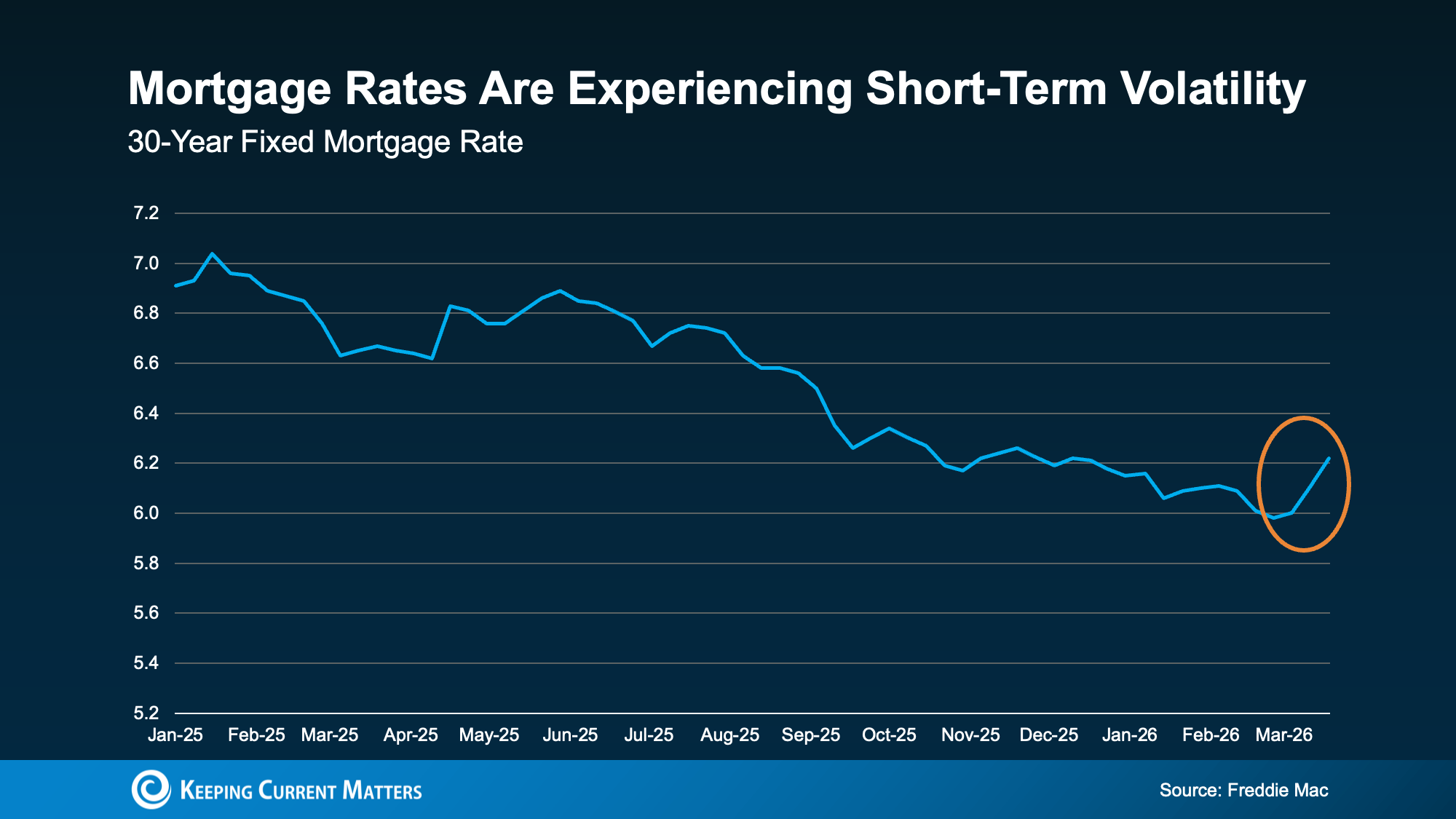
Data from Freddie Mac shows the recent volatility. After trending down for well over a year, there was a rise this month (see graph below):

a graph showing a line of a moving rate

While it’s easy to be distracted by the changes, here’s what you need to remember.

It’s normal for rates to bounce around a bit here and there. For example, if you look back at the graph, you’ll see that even within the past year there have been times like this when rates inched up. We’re in one of those moments right now and you need to be aware of that.

Especially when there’s economic uncertainty or big global events happening, volatility like this is expected. As Investopedia explains:

“Mortgage rates don’t move in isolation. When global events inject uncertainty into financial markets . . . that can ripple through to borrowing . . . mortgage costs can respond quickly to geopolitical developments. As long as uncertainty remains elevated, rate swings may continue.”

And that’s one of the reasons why trying to time the market isn’t a wise move.

You can’t control what happens with mortgage rates. But there are still things you can do to help you get the best rate possible in today’s market. And here’s where to focus your effort.

Your Credit Score

Your credit score plays a big role in the rate you qualify for. Even a small improvement can make a noticeable difference in your monthly payment. As Bankrate puts it:

“Your credit score is one of the most important factors lenders consider when you apply for a mortgage. Not just to qualify for the loan itself, but for the conditions: Typically, the higher your score, the lower the interest rates and better terms you’ll qualify for.”

So, make sure you do what you can to keep your credit score up. If you’re not sure what your score is or how you can improve it, talk to a trusted loan officer.

Your Loan Type

There are also different types of home loans – and each one can have unique requirements, benefits, and rates for qualified buyers. The Consumer Financial Protection Bureau (CFPB) explains:

“There are several broad categories of mortgage loans, such as conventional, FHA, USDA, and VA loans. Lenders decide which products to offer, and loan types have different eligibility requirements. Rates can be significantly different depending on what loan type you choose.

That’s why it’s so important to explore your options with a lender. You may even want to talk to multiple lenders to see how the options vary.

Your Loan Term

The length of your loan matters too. Most lenders typically offer 15, 20, or 30-year loans. Freddie Mac offers this advice:

“When choosing the right home loan for you, it’s important to consider the loan term, which is the length of time it will take you to repay your loan before you fully own your home. Your loan term will affect your interest rate, monthly payment, and the total amount of interest you will pay over the life of the loan.

Again, to figure out what makes the most sense for your budget and long-term goals, have a lender walk you through all your options.

Bottom Line

Thinking about buying right now? The best advice is to accept that you can’t control where rates are going to go from here.

What you can do is work with a trusted lender and take steps that’ll help you get the best rate possible.

So, if you want to move today call me, Clarence Oliveira at 209-988-5254, to make it happen. You just need to control the controllables and focus where it counts.

Source: keepingcurrentmatters.com ~ By: keepingcurrentmatters.com ~ Image: keepingcurrentmatters.com


Is It Finally a Buyer’s Market? Here’s How To Tell and What To Do About It

Is It Finally a Buyer’s Market? Here’s How To Tell and What To Do About It

If you’re buying or selling a home right now, one question is likely on your mind: Who holds the power in today’s market?

After years of sellers calling the shots, the balance is edging back toward buyers.

Inventory has risen 10% year over year for the 27th straight month; though, on a monthly basis, active inventory fell 6.8% since December, according to the Realtor.com® January Monthly Housing Trends Report.

Buyer activity certainly increased in January, as pending home sales—listings under contract—grew by 1.2% year over year, but that number could continue to increase in February and March as mortgage rates finally hit a three-year low and actually fell below 6% on Feb. 26.

The signs are pointing to a more buyer-friendly market more than ever, which aligns with the Realtor.com forecast for 2026. Here’s how to read the signs and navigate this point of flux, whether you’re buying, selling, or just watching and waiting.

What does a buyer’s market mean?

In the simplest terms, a buyer’s market happens when the number of homes for sale exceeds the number of active buyers. This shift in supply and demand gives buyers more leverage as sellers compete to outshine one another.

That means more choices, more room to negotiate, and often, more time to decide for buyers.

This is a notable contrast from the seller-dominated market that’s defined much of the past decade. Since the aftermath of the 2008 financial crisis, new-home construction lagged far behind demand, and buyers competed fiercely over limited inventory.

But in today’s slowly shifting market, the balance of power is beginning to tilt, even if it hasn’t full

Indicators of a buyer’s market

How do you know when the housing market is tipping toward buyers? There are several key signals:

High inventory

“The best single indicator for this is months supply,” explains Danielle Hale, chief economist of Realtor.com. “Typically, months’ supply above six months is the hallmark of a buyer’s market.”

To her point, newly listed homes edged up 0.7% year over year and surged seasonally from December, while pending sales rose 1.2% year over year—their strongest annual gain since late 2024

Active listings are still 17.2% below pre-pandemic norms, though, the widest gap since spring 2025

“Homebuyers and sellers can also look for other clues that go hand in hand with a buyer-friendly shift,” says Hale.

Location offers a significant indication: Inventory grew year over year in 46 of the 50 largest metro markets. Only Jacksonville, FLSan FranciscoChicago, and Grand Rapids, MI, saw a very slight decline in active listings. Seattle experienced the most notable surge (+32.4%), followed by Charlotte, NC (+28.6%), and Washington, DC (+26.8%).

All of this means buyers are finally seeing more options, but not everywhere—and not evenly.

Slower sales

Homes are taking longer to sell across nearly every region. In January, the typical listing spent 78 days on the market—five days longer than a year ago. It was the 22nd consecutive month of slower sales.

“In a buyer’s market, sellers can typically expect it to take longer to sell a home, and they may have to reduce their home price—either directly in the listing or by accepting a below-asking-price offer—to ultimately make a sale,” explains Hale.

This is advantageous for buyers, explains Hale.

“Buyers can expect that they will not only have more options to choose from, but also have more time to consider their choices,” she says.

But it comes with a major caveat, says Realtor.com senior economist Jake Krimmel.

“Delistings are growing faster than inventory overall, and in some markets, for every two or three fresh listings, one home is being pulled.

“It’s a way for sellers to reassert control in a market where their leverage is fading,” he adds.

Price drops

With listings lingering, price cuts have become a defining feature of the market. Price cuts slightly decreased year over year, with 14.3% of listings discounted, down from 15.6% in January 2025.

Discounts are most common for homes in the $350,000 to $500,000 range, where affordability pressures are sharpest and sellers are more motivated. At the luxury end—$1 million and up—price reductions remain relatively rare as high-end sellers hold out for the right offer.

Concessions

More motivated sellers can also show up in concessions. Mortgage broker Carlos Scarpero has seen a growing number of sellers offer financial perks to seal the deal.

“Even within cities and price points, trends can vary,” he explains. “I’ve closed several deals in 2025 with $10,000 or more in seller concessions. This is certainly higher than I have seen in years past.”

While these indicators vary by region and price tier, the pattern is becoming clear: Sellers are no longer in complete control, and buyers are starting to regain ground.

Is it a buyer’s market right now?

It depends on where you are.

When measured by months of supply, MiamiAustin, TX, and Orlando, FL, rank as the strongest buyer’s markets right now. Tampa, FLNew York City, Las Vegas, and Riverside, CA, follow, respectively.

While buyers may have more leverage in these cities, real estate experts warn that it won’t be felt evenly across all segments of the market. Miami is a strong example.

While demand for condos priced below $500,000 has plummeted, single-family homes remain near impossible to find. On the off chance one hits the market, you’re likely to get burned treating it like a condo.

In other words, “know your segment,” Ana Bozovic, a Miami-based real estate agent and founder of Analytics Miami, told Realtor.com earlier this month.

The same can be said of the national housing market, which is in perfect balance right now. That means more buyer-friendly conditions than there have been in years.

“We’re continuing to see the market shift in favor of buyers,” says Matt Ryan of Bozeman Real Estate Group. “In Bozeman, MT, inventory has finally returned to pre-COVID levels, giving buyers more choices and negotiating power. I expect this trend to continue.”

That buyer-friendliness is showing up at the local level, too.

“It’s definitely been tipping in the direction of buyers lately,” says Brooke Nelson, a ReeceNichols agent in Kansas City, MO. “Showings have really slowed down.”

And in some markets, the shift is already playing out in negotiations.

“Every buyer I’m working with that makes an offer is getting a contract accepted,” notes Mason Whitehead, a branch manager at Churchill Mortgage.

Local and regional variations matter most

While national headlines might suggest a buyer’s market is taking hold, the reality on the ground depends heavily on where and what you’re trying to buy. Local trends can diverge sharply from national averages, especially when you factor in price range, property type, and post-pandemic market dynamics.

In some high-demand pockets, homes are still moving quickly, especially if they’re priced right and well-prepared.

“Buyers have the most negotiating power in the condo market,” explains Aaron Buchbinder, a broker with Compass in South Florida. “On the flip side, single-family homes in prime locations are still seeing strong interest and less flexibility.”

That kind of split isn’t unique to Florida. In many metro areas, buyers might find leverage in one segment while still facing competition in others.

While national stats offer a useful snapshot, the real leverage is local. Buyers and sellers alike should compare today’s conditions with their market’s own history, not just the national narrative. What seems like a cooling market in one city might still be red-hot in another.

What to do if you’re a buyer

With market conditions starting to tilt in buyers’ favor, now might be the time to act, but strategy still matters. After all, competition hasn’t disappeared entirely. Here’s how to make the most of your position:

Get pre-approved

Even in a cooling market, speed can make or break your offer, especially in competitive neighborhoods or price tiers. A pre-approval letter shows sellers you’re serious and ready to move.

Watch the days on the market

Homes that have lingered on the market are increasingly ripe for negotiation.

“Buyers should not be concerned with higher days on market,” says Melissa Bailey, a top agent with the Jason Mitchell Group. “Go see the home that has been listed for 62 days. It could be your home!”

Use contingencies and timing strategically

In a more flexible market, buyers can regain tools they were often forced to waive, like inspection or appraisal contingencies.

“Right now, the biggest advantage is the ability to buy and sell at the same time—sellers are more open to contingent offers and willing to negotiate,” explains Ryan.

Being flexible with closing dates or offering quicker timelines can also help you stand out without raising your offer price.

Stay up to date

Understanding local inventory trends, median days on the market, and pricing patterns can help you recognize when a listing is overreaching and when it’s genuinely a deal.

In today’s market, knowledge is leverage, and a well-informed buyer can often win without overpaying.

What to do if you’re a seller

While the market might be softening, it’s still a solid time to sell if you adjust your approach to today’s more selective buyers. Here’s how to stay competitive and avoid sitting on a stale listing.

Price realistically

Gone are the days of aggressive overpricing and instant bidding wars. Today’s buyers are more cautious and cost-conscious.

“Sellers who were unrealistic in Q1 are adjusting to today’s buyer expectations,” says Darin Tansey, director of luxury sales at Douglas Elliman.

Listing high in hopes of negotiation room could backfire, especially with inventory rising. A well-priced home will attract more attention and better offers upfront.

Prepare your home well

Buyers are still drawn to clean, move-in-ready homes, and the basics still matter. Invest in staging, photography, and curb appeal. A strong first impression can make the difference between a quick offer and weeks of radio silence.

Know your market

In some areas, homes are still moving fast. In others, they’re lingering. The more your agent understands local demand, the more they can guide pricing, marketing, and timing strategies.

Don’t panic

Yes, buyers are gaining leverage, but that doesn’t mean you’re at a disadvantage.

Adjusting to this new reality doesn’t mean giving up value; it means staying nimble. Well-prepared, fairly priced homes are still selling, and in many areas, sellers remain in the driver’s seat, just with a lighter grip on the wheel.

A shift, not a flip

While it might seem like the market is suddenly favoring buyers, the reality is more nuanced.

“We’ve been in a seller’s market pretty consistently since 2016, when months’ supply averaged 4.4 months across the year. Since then, it’s averaged four or lower, signaling a tough market for buyers. Given the persistence of underbuilding relative to housing demand over the last decade, it’s not surprising that we have been through a really persistent seller’s market,” says Hale.

After years of seller dominance, conditions are gradually becoming more favorable to buyers. Inventory is up, price cuts are more common, and homes are taking longer to sell. But in many markets, especially in desirable neighborhoods or lower price tiers, sellers still hold meaningful leverage.

“While some are calling this housing market a buyer’s market, I would say that it’s more of a market in transition,” says Hale.

That means that while sellers won’t need to sacrifice all their power, they will need to adjust expectations.

“It is not realistic to expect multiple offers pushing home prices over market value,” says Missy Derr, a real estate adviser with Engel & Völkers in Atlanta. “Buyers finally have more than a fair shake at securing a home.”

Whether you’re buying or selling, this isn’t the time to rely on headlines alone. The national market might be cooling, but the story varies neighborhood to neighborhood. That’s why it’s more important than ever to watch local trends, compare current conditions to pre-pandemic norms, and work with an agent who understands the intricacies of your area.

Source: realtor.com  ~ By Allaire Conte ~Image: realtor.com

Why Some Homes Sell Quickly – and Others Don’t Sell at All

Why Some Homes Sell Quickly

A few years ago, inventory hit a record low. Just about anything sold – and fast. But now, there are far more homes on the market. Listings are up almost 20% from this time last year. And in some areas, supply is even back to levels we last saw in 2017–2019. For sellers, that means one thing:

Your house needs to stand out and grab attention from day one.

That’s especially true when you consider why the number of homes for sale is up. Here’s how it works. Available inventory is a mix of:

  • Active Listings: homes that have been sitting on the market, but haven’t sold yet
  • New Listings: homes that were just put on the market

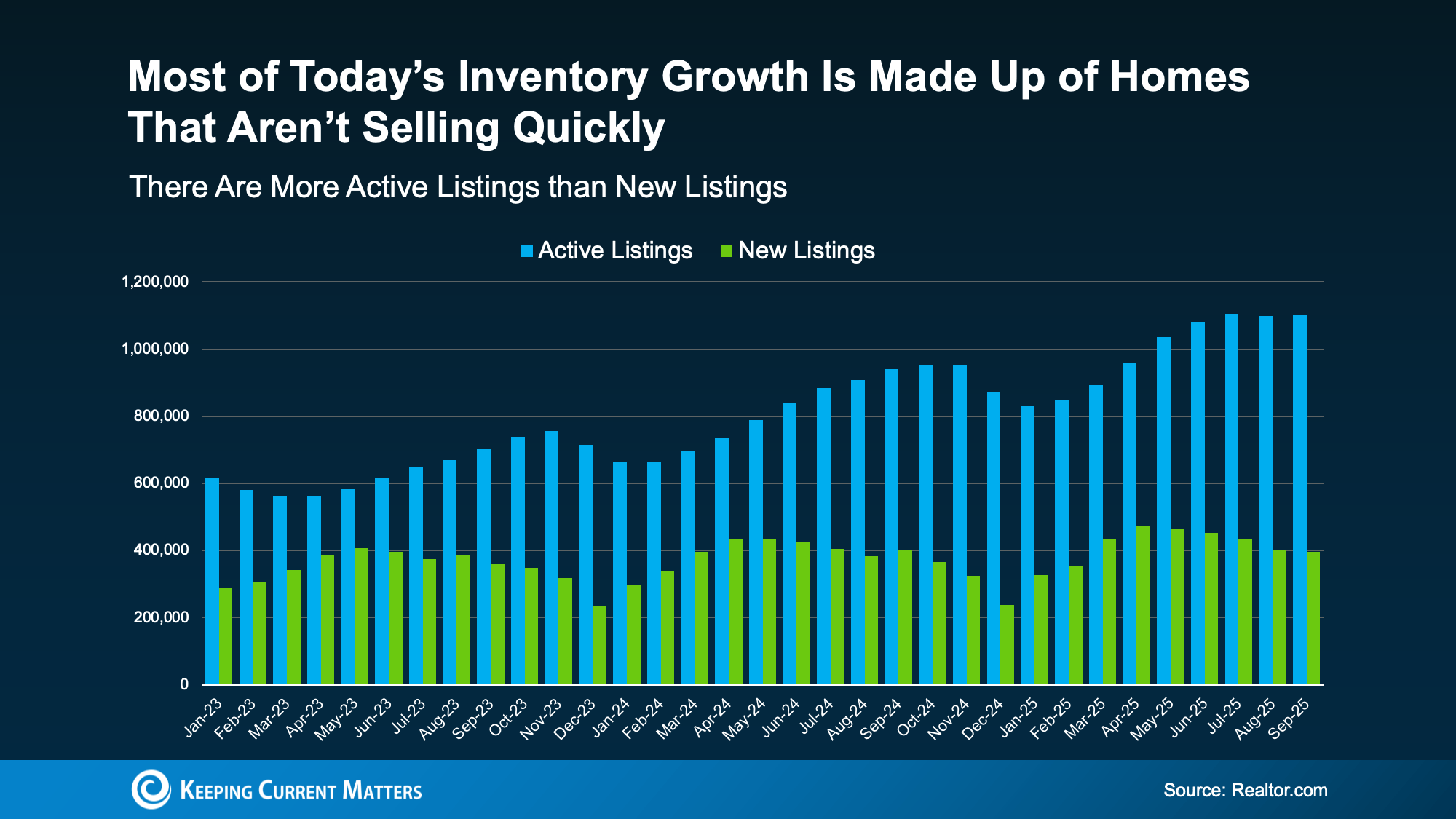
Data from Realtor.com shows most of the inventory growth lately is actually from active listings that are staying on the market and taking longer to sell (see the graph below).

The blue bars show active listings. These are the homes that are sitting month to month and not selling. The green bars are new listings, the homes that were just put on the market. And it’s clear there are fewer new listings compared to how many are staying on the market unsold.

Since you don’t want your house to be one of the ones that take a long time to sell, let’s break down where things can go sideways and how to set yourself up to sell quickly.

Why Some Homes Sell and Others Sit

The secret to selling in today’s market is simple. Make sure your house is easy for buyers to say yes to as soon as it is listed.

Price it based on current conditions (not what your neighbor sold for 3 years ago). Make important repairs. And highlight the best things about your house. If you do that, it will sell in any market – sometimes even faster than you’d think. Because the truth is, homes that are priced right today are still selling. 

It’s the homeowners who are clinging to outdated expectations that are seeing their house sit and their listing go stale. According to Redfin and HousingWire, here are some of the most common reasons sales stall out:

  • Priced it too high from the start
  • Skipped necessary repairs before listing
  • Didn’t stage the house well
  • Sellers won’t negotiate with buyers
  • Limited availability for showings
  • Ineffective marketing or listing pictures

Most of those things didn’t matter as much just a few years ago. When inventory was at a record low, sellers could skip the prep, name their price, and still walk away with multiple offers over their asking price.

But today’s market is different now that inventory has grown. And that means your approach needs to be different too.

You don’t want to try out old strategies and aim too high just to see what sticks. Your first few weeks on the market are everything. That’s when your listing gets the most attention – and when pricing or presentation mistakes hurt the most. Get it wrong up front and your house will sit…and sit. Get it right, and it’ll be snatched up before you know it.

The Right Agent Helps Your House Stand Out

Selling quickly isn’t about luck. It’s about knowing how to play to the market you’re in. And that’s where your agent comes in.

A great agent will analyze your local market, suggest a price based on the latest comparables sold in your neighborhood, and create a marketing plan that makes buyers pay attention from day one. They’ll also walk you through any repairs you need to make or whether you need to bring in a staging company. As the National Association of Realtors (NAR) explains:

“Home sellers without an agent are nearly twice as likely to say they didn’t accept an offer for at least three months; 53% of sellers who used an agent say they accepted an offer within a month of listing their home.”

That’s the power of getting it right (and getting expert help) from the start.

Bottom Line

There are more homes for sale today, but that doesn’t have to work against you.

When your house is priced right, shows well, and is marketed effectively, it will sell. Connect with an agent if you want to know how to make that happen in your market this fall.

Home Selling Myths, Debunked

Home Selling Myths, Debunked

Whether you’re a Realtor, mechanic, or even a doctor, chances are you spend a good portion of your day dispelling common myths about your job.

The real estate industry constantly changes. Still, some common home-selling myths persist even after they’ve been debunked. Let’s take the enduring belief that you need a hefty 20% down payment to buy a home, which continues to be a misconception. I’m here to set the record straight and help my readers know real estate fact from fiction. I compiled this list from years of experience with buyers and sellers and real estate stories from my mentees. So, let’s turn up the brightness and shed some light on the real estate industry.

Setting the Right Expectations

Myth #1: Going With the First Buyer Is Rarely the Best Choice

After navigating hundreds of real estate deals, I can confidently say that your first offer is nearly always the best. It’s often the strongest in terms of price and conditions. However, I’ve seen it time and again: Sellers want to “hold out for a better offer.” You can help your seller by offering perspective—flip the situation and help your seller imagine themselves in the buyer’s shoes.

Let’s imagine one of those “grass is greener” homeselling myths: Perhaps that first offer on your new listing came through in just three days (and above the asking price) because that buyer could have been waiting for just the right home. When they saw your listing, they put their best foot forward because they really wanted the home. For your sellers, it’s in their best interest to negotiate here, not just to decline the offer waiting for a better one.

Fact: Now, it’s your job to educate and coach your clients. This is one of the top blunders your sellers could make. That first offer is like a golden opportunity that could save months of inconvenience, stress, and anxiety. No more constant showings and feedback, ongoing HOA dues, or the worry of repairs (not to mention balancing a mortgage payment). After all, a new listing on the MLS gets the most attention in the first week. Then interest starts to taper off. Plus, every offer on the table is just a jumping-off point.

Myth #2: Wiggle Room in Pricing Is Essential for Negotiation

The market price of a home can fluctuate by tens of thousands of dollars over a year. If you’ve got an overpriced listing on the market, it gets staler every day that the listing is available. During the housing boom of 2021, homes that were on the market for longer than a week had a perception that something was wrong with them. Then, when the price drop happens, you have to justify the price cut to other agents.

The truth is a big piece of a real estate agent’s job is to price a listing accurately. The thing is, it can be tricky. You’ll most likely get three different numbers if you have three different real estate agents conducting a CMA.

Fact: There’s no reason to “leave some wiggle room” to get the highest offer. When pricing a home to list, only you, as the listing agent, know all the significant factors that drove the pricing on this home. Don’t let the listing get stale because your sellers thought they might get a good offer. So, our job is to listen to the client’s situation and what they’re expecting. The highest price is usually their motivation, but not always!

Myths #3: Listings Sell Themselves 

Listen, was there a time when you just listed a home without photos, and it would get multiple offers? Sure. That time is not now. Marketing your listings is one of those pieces that is done behind the scenes.

However, nowadays, agents need to pay attention to every little detail. Just how the photos are placed in order can affect the views on a listing. It takes looking at dozens and dozens of listings to get a feel for what works—and what doesn’t.

Fact: As a real estate professional, you need to be confident in order to successfully market a listing. Sellers will ask, What are you doing to sell my home? Be prepared to answer this question. Home sale preparation is done like a dealership preps the cars for the lot. Perhaps it looks like they just posted a sign in the window. Still, the car was detailed, professionally photographed, staged, posted online, and syndicated to numerous websites to find a buyer. Selling a home is the same—it’s not just a sign in the yard and a posting on the MLS. Once you have your full real estate marketing checklist, you can execute it quickly.

Preparing Your Home for Sale

Myth #4: Your Home Should Reflect Your Personality

Sellers, especially those who have lived in their home for decades, are attached. They have a hard time taking down their personal or sentimental items. However, potential homebuyers can be detail-oriented (and rightfully so!). Speaking from experience, they can also get hung up on very minor details, like what types of books are in the cabinet and the style of the laminate flooring. So, while those small changes are simply cosmetic, they can be a tough hurdle for some buyers.

Be mindful as well of the fact that emotional attachment can be a burden to potential buyers. It can alienate some buyers if a home looks “lived-in.” I also stress to my clients that personal effects aren’t welcome because of strangers. Privacy and safety concerns are real, and while most folks are reasonable people and accompanied by their agent during a showing, you can never say for sure.

Fact: Your listing looks best when it’s easy for buyers to see themselves living there. You’ve got to remove the clutter, kids’ toys, and personal artwork. Let’s think back to the reference of a car from a dealership: you wouldn’t want personal effects like preprogrammed radio stations, stickers on the dashboard, and trinkets hanging from the rearview mirror. It’s best to showcase your home or listing as a blank canvas for buyers to imagine their new lives.

Myth #5: Buyers Prefer an ‘HGTV Style’ Home Remodel

HGTV brought a lot of great things to homes—interior design on a budget, a newfound love for historic homes, and, of course, the dreaded open floor plan. These days, it seems like an open floor plan is all the rage with homeowners. However, that opinion is starting to change—once buyers realize that the lack of privacy and loud noises throughout the house isn’t ideal!

Investments & Improvements

Myth #6: Major Renovations Guarantee a Return on Investment

Home tastes and styles change. While knocking walls down can seem easy, putting them back up is much harder. Every buyer has their own taste, and a complete kitchen remodel may not drastically change the value of a home. People are ready to list their homes, and the next thing they think about is prepping it. They know their kitchen is probably outdated, so they convince themselves they must spend $20,000 to remodel.

Unfortunately, you’re just giving yourself a headache. Sure, the curb appeal may be better, but consider the fact that appraisers don’t factor in the cost of appliances or upgrades when determining a home’s value.

Fact: People really think a big remodel is important. Some clients may even ask if they should look into a HELOC for renovations. Unless substantial improvements are needed, like mold mitigation, your sellers should avoid anything that takes longer than a few hours. Plus, consider the fact that if an issue arises during the inspection, they can offer a credit to keep the deal moving forward. That’s most likely easier and faster than replacing an entire system or a big renovation. Consider a less costly improvement, like resurfacing the cabinets or upgrading the sink, to help the kitchen stand out.

Myth #7: Converting the Garage Into an ADU Increases Property Value

With the short-term rental craze rising, some folks are looking for a way to add an accessory dwelling unit (ADU), either through a basement, garage, or large shed, to increase their value instantly. This is one of those ideas that can be better in theory than in practice.

Homeowners can spend upward of six figures on an ADU renovation to provide complete electrical, plumbing, and furnishings in an accessory unit. They expect that it will raise the value of their unit when, in fact, that square footage cannot be added to the total square footage by an appraiser. Essentially, it will add very little (if anything) toward the value of your home.

Fact: If your sellers want to renovate or upgrade, spend the money on the bathrooms and the kitchen. These renovations are where they’re more likely to see an improvement in the value of their home. Plus, you’re not limiting the potential buyer pool to those folks who are only interested in an ADU. You’ll also need to contend with zoning, permits, and perhaps even short-term rental restrictions set in place by the HOA (or even the city). It’s not worth it.

Myth #8: Getting Pre-approved Should Happen After Finding Your Perfect Home

House hunting can be exhausting. Even just showing a home takes a lot of coordination. If a buyer loves the home but has no way financially to prove that they 1) are serious about a purchase and 2) can finance it, then you’ll need to send them to a lender. A pre-approval won’t take long and can save your buyer a headache if they find a home they love before realizing they can’t get a mortgage to pay for it.

Fact: Sometimes buyers can be pushy about this. However, you must assure them that showing they can buy the home is the first step. If it’s a cash buyer, ask to see the pre-approval letter or proof of funds—and even if they have the contact information for their lender or banker. As we mentioned in our article on how to tell when your client is lyingtrust but verify.

Myth #9: Larger Brokerages Offer Superior Services

One of the more common misconceptions revolves around the belief that the size of the brokerage determines the effectiveness of your marketing (and perhaps pricing!). With the advent of internet syndication, your MLS exposure is pushed out to dozens of other sites without being part of a large brokerage. This syndication includes real estate websites with the most traffic, like Zillow and Realtor.com.

Fact: The quality of MLS entries matters more than the brokerage size for effective exposure. Plus, what else are you doing to advertise the home? Do your listing services include mailers or any unique exposure? If you’re at a smaller boutique brokerage, do you pride yourself on providing superior service to your clients? Speak to those past experiences by highlighting your referrals. Make yourself stand out, and the results will speak for themselves.

Modern Marketing Strategies

Myth #10: Still Photos on the MLS Are Enough 

At this point, some agents may argue that traditional still photos have served the industry well for years. However, 97% of all homebuyers used the internet in their home search. It’s your duty to showcase a home in its best light. Buyers need to be attracted to your listing—and that starts with professional photos.

Relying on still photography won’t be sufficient to capture the attention of today’s tech-savvy (and visually oriented) buyers. The truth is that the real estate landscape has evolved, and so have the expectations of potential buyers. People want floor plans and a 360-home tour.

Fact: Many real estate photographers offer upgraded packages that include twilight photos, drone footage, floor plans, and 3D home tours like Matterport. While there are rare instances like “as-is” investment properties, try to upgrade your digital marketing to showcase property online as best as possible. There are tools like Pivo.ai and Zillow 3D home tours that you can easily upload to your listing. You can even use photo editing software like Phixer to edit your hero shot on the MLS. Note that myths about selling your home during holidays apply here: if your listing photos still have snow in them and it’s not the season, it’s time to re-shoot.

Myth #11: Open Houses Are a Necessity for Selling a Home

This is a typical homeselling myth that may benefit agents. After all, we’re huge fans of agents hosting an open house—but remember that hosting one is more for your benefit as an agent to leverage your listing for leads. If the home isn’t vacant and it’s a bother to your sellers, don’t push your clients to use their space for an open house.

Fact: Some agents believe open houses are on the decline. While COVID took its toll on open houses, they’re still a great way to get your listing (and your brand) out to the public and the neighborhood. Looking for tips to supercharge your next open house? Check out our list of 33 Open House Ideas That Will Actually Get You Leads.

Bringing It Together

It’s tough out there for real estate professionals. You’ve got a lot of hats to juggle, and honestly, myth-busting will be another one to add to the stack. As the late American president John F. Kennedy said, “The great enemy of truth is very often not the lie: deliberate, contrived and dishonest, but the myth: persistent, persuasive and unrealistic.”

Next time you’ve got a client with hard-stuck—and possibly outdated—beliefs about the industry, try to point them in the right direction with facts, not opinions. Feel free to share this article with your office (perhaps even your clients). And if you’ve got a myth about the real estate industry that we didn’t cover or a tip for busting myths, share it in the comment section!

Source: theclose.com ~ By: Trever James ~ Image: theclose.com

7 Tips for First-Time Homebuyers

7 Tips for First-Time Homebuyers

Buying your first home can be exciting—and stressful. Beyond the challenge of finding the right home in your chosen neighborhood, many financial questions are sure to arise. With advance planning—and saving—the homebuying process will be much easier.

Our top tips:

  1. Don’t buy a home primarily as an investment. You can’t rely on home values always rising. If financial return is your primary goal, plan to own a property for at least five years.
  2. Know what you can afford. Use a mortgage calculator to figure out how much you can borrow based on your income and financial obligations. As a rule, keep your housing costs below 31–40 percent of your gross monthly income.
  3. Check your credit score. Having a better credit score can mean lower mortgage rates. Take steps to boost your score before you start house hunting.
  4. Understand the other costs involved.
    • Plan to pay property taxes and carry homeowner’s insurance.
    • A home inspection can help you plan for major repairs and routine maintenance.
    • A condo or home in a community that offers shared facilities like a pool may have monthly association fees.
    • Closing costs can be between 1.5-5 percent of the purchase price. These include mortgage applications, appraisal, transfer of property fees, and government recording fees. California is an escrow state, which means that funds are held by a third party to cover property taxes and insurance.
  5. Save for a down payment. For a conventional loan in California, a minimum down payment is 3% of the home price. However, the average down payment is 13%. Ideally, plan to put down at least 20% of your mortgage. Otherwise, you will have to pay private mortgage insurance (PMI) premiums on top of your mortgage payments until your Debt-to-Income (DTI) Ratio reaches 80%. The larger your down payment, the easier it will be to qualify for a mortgage and negotiate the lowest rate. Plus, when sellers review multiple offers, the more you put down, the more competitive your offer will be with other bids.
  6. Know what documents you need for your loan. Commonly requested loan documents include a fully executed agreement of sale for the property being purchased, bank and brokerage account statements, pay stubs, previous W2s, IRS Form 4506 (which authorizes a mortgage lender to obtain copies of your tax returns from the IRS), and homeowners’ insurance policies.
  7. Get pre-approved for a mortgage. Get a preapproval letter from a competitive mortgage broker that specifies how much a lender is willing to lend you and locks in the rate. This lets real estate agents and sellers know that you’re a serious buyer because your financing is already arranged. In competitive markets, many realtors now ask for a preapproval letter before showing any properties or entering a contract with a buyer.

Additional resources:

Source:

Patience Won’t Sell Your House. Pricing Will

Patience Won’t Sell Your House. Pricing Will

Waiting for the perfect buyer to fall in love with your house? In today’s market, that’s usually not what’s holding things up. And here’s why.

Let’s be real. Homes are taking a week longer to sell than they did a year ago. According to Realtor.com:

“Homes are also taking longer to sell. The typical home spent 60 days on the market in August, seven days longer than last year and now above pre-pandemic norms for the second consecutive month. This was the 17th straight month of year-over-year increases in time on market.”

Part of that is because there are more homes on the market. So, with more options for buyers to choose from, they aren’t getting snatched up quite as fast. But there’s another big reason: price.

The Average List Price Isn’t Going Up – and That Matters

Today, a lot of homeowners are overshooting their list price. They remember the big climb in home prices a few years ago, and they don’t realize how much has changed.

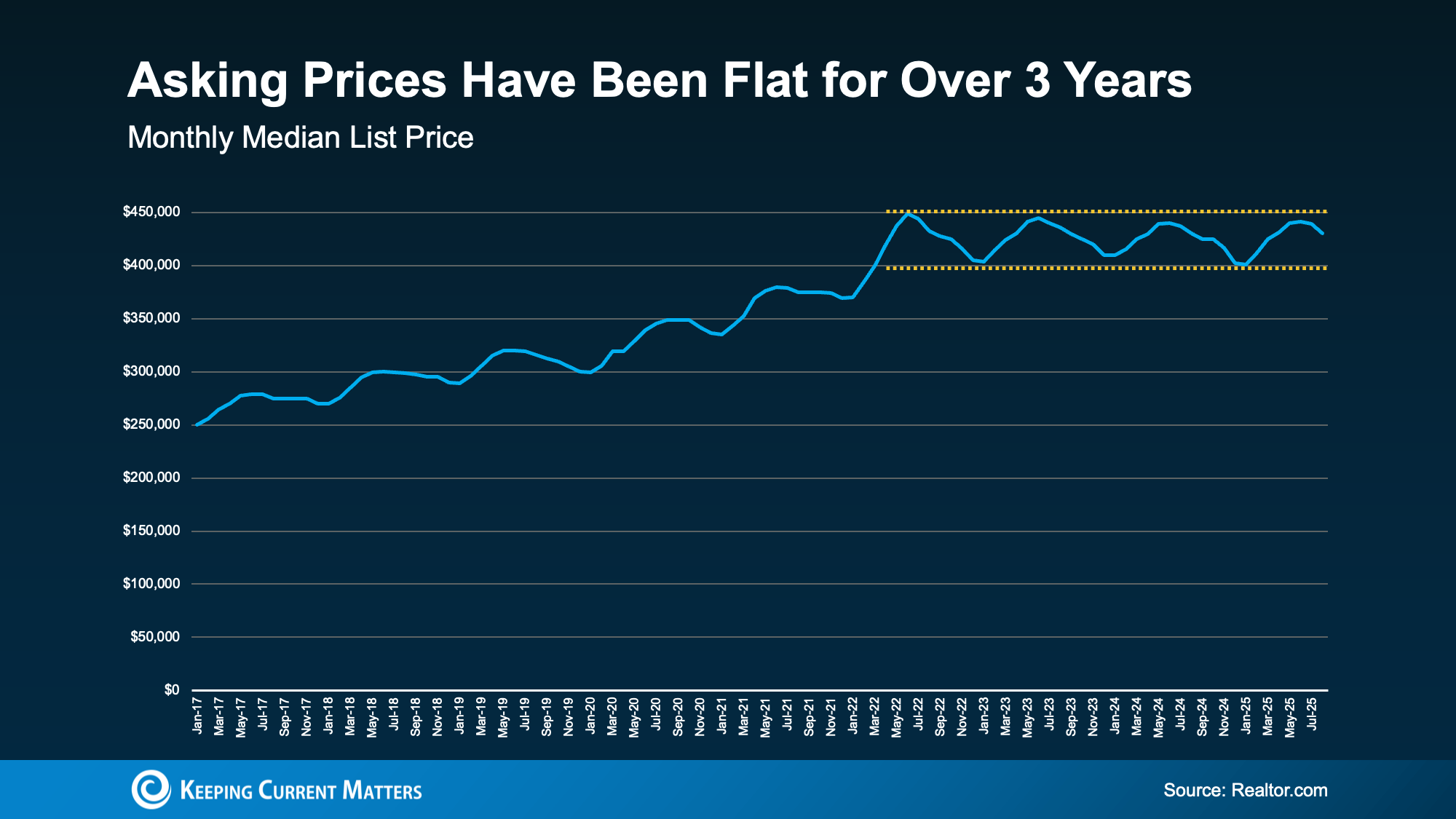
One of the most important, but often overlooked, changes in today’s housing market is this: average list prices have held steady for the past few years.

That’s a big shift from a typical market, where prices were rising steadily each year. And it’s significantly different than the 2021-2022 surge when sellers could set their price just about anywhere and still attract multiple offers over asking.

But now? That trend has leveled off – and sellers who want to stay competitive need to take note (see graph below):

a graph of a priceHere’s what this says about today’s market. Buyers are a lot more price sensitive now. And sellers can’t keep trying to inch the bar higher, or their house will sit without any offers.

Homeowners who expect to bring in more than their neighbors did last year may be setting themselves up for a longer, more frustrating experience.

And while homeowners are starting to realize prices can’t keep climbing at such a rapid pace, the hiccup is that list prices aren’t actually coming down yet as a result. They’re hanging around, holding steady. And sellers who make this mistake are often holding onto hope that they’ll be able to eek a few more dollars out of their sale. But that’s the problem right there.

If you want to sell today, you need to be in line with where the market is today. Not last year. Not during the pandemic. Today.

Because buyers will skip over homes that feel overpriced, even if it’s only by a little. It’s not that they aren’t interested. It’s just that in a market with more homes to choose from, buyers can be more selective, and sellers don’t get the same benefit of the doubt. If your house isn’t priced to sell, buyers just move on. They’ve got other options anyway.

4 Signs Your Price May Be Too High

You may already be feeling this yourself. If your home is listed and you’re not seeing results, watch for these common red flags noted by Bankrate:

  1. You’re not getting many showings
  2. You haven’t gotten any offers (or you’ve only gotten lowball offers)
  3. Buyers that do come to see your house leave overly negative feedback
  4. Your house has been sitting on the market longer than the average for your area

If any of these sound familiar, know that waiting it out won’t fix it. But adjusting your price will.

So, What’s the Solution?

Work with your agent to make sure your house is positioned for today’s market. Depending on your what’s happening in your local area, a few weeks without traction can raise questions for buyers about whether your price is realistic. And don’t worry – it doesn’t have to be a big drop. Even a small adjustment can be enough to bring the right buyers through the door.

And if you’re worried you won’t get the high-ticket sale price you thought you would be able to land, keep in mind that your equity has probably grown quite a bit. Chances are, you’re still ahead of the game simply because you invested in a home over the last 5, 10, or more years. You’re still winning when you sell today.

Bottom Line

Patience isn’t a strategy. Pricing is.

If your home isn’t moving, the market is telling you something – and the right price can change everything. Your house will sell, if you price it strategically.

Talk to your agent about what buyers are willing to pay right now to make sure your home stands out for all the right reasons. 

Source: keepingcurrentmatters.com ~ Image:

The Advantages of Selling your Home using a Real Estate Agent

The Advantages of Selling your Home using a Real Estate Agent

When selling a home, the decision to hire a real estate agent is a significant one. While it involves paying a commission, the advantages a professional agent brings to the table can save you time, reduce stress, and, most importantly, help you secure a higher sale price.

Here are the key advantages of selling your home with a real estate agent:

1. Expertise and Market Knowledge

  • Strategic Pricing: A good real estate agent is an expert on local market trends. They will conduct a Comparative Market Analysis (CMA) of similar homes that have recently sold in your area. This data-driven approach helps you set a competitive price that attracts serious buyers, ensuring you don’t overprice your home (and deter buyers) or underprice it (and leave money on the table).
  • Understanding of Market Conditions: An agent is immersed in the real estate market daily. They know how to interpret market data, including supply and demand, the average time homes are on the market, and local economic factors that can influence your sale.

2. Powerful Marketing and Exposure

  • Access to the MLS: The Multiple Listing Service (MLS) is the most powerful tool in the real estate industry. Only licensed agents can list a property on the MLS, which syndicates your home’s information to thousands of real estate websites, including Zillow, Redfin, Realtor.com, and more. This gives your home maximum visibility to a vast network of potential buyers and their agents.
  • Professional Photography and Staging: A real estate agent will typically coordinate professional photography, and possibly videography and virtual tours, to make your home stand out online. They also provide expert advice on staging and minor repairs that will make your home more appealing and increase its perceived value.
  • Leveraging a Professional Network: An agent can tap into their network of other real estate professionals, previous clients, and industry contacts to generate buzz and find potential buyers before your home even officially hits the market.

3. Skilled Negotiation and Legal Guidance

  • Objective Representation: Selling a home can be an emotional process. An agent acts as an objective third party, helping you stay focused on the business aspects of the transaction. They can skillfully handle negotiations without being swayed by personal feelings.
  • Expert Negotiator: Your agent is experienced in negotiating not just the sale price, but also other critical factors like contingencies, inspection repairs, closing costs, and the closing date. Their expertise can help you get the best possible terms and navigate complex situations that can arise.
  • Handling Paperwork and Legal Compliance: A real estate transaction involves a mountain of paperwork, including contracts, disclosures, and legal documents. An agent is well-versed in this process and can ensure all the necessary forms are filled out correctly and on time, protecting you from potential legal risks.

4. Time Savings and Convenience

  • Buyer Vetting and Showings: An agent saves you from the hassle of coordinating and managing showings. They will screen potential buyers and their agents to ensure they are pre-qualified and serious, reducing the number of “looky-loos” and protecting your privacy and security.
  • Streamlined Process: From the initial consultation to the final closing, your agent handles all the logistics. They coordinate with other professionals, such as lenders, inspectors, and appraisers, to keep the transaction on track and ensure a smooth closing.

The Bottom Line: A Better Sale Price

While the commission is a cost to consider, numerous studies by organizations like the National Association of Realtors (NAR) have shown that homes sold with a real estate agent typically sell for a significantly higher price than homes sold by the owner (FSBO). This difference in sale price often more than covers the agent’s commission, resulting in a higher net profit for the seller.

Image: Canva Pro

Home Title Theft: How to Prevent It

Home Title Theft: How to Prevent It

It’s possible for someone to steal your home from right under your nose. Learn how to prevent it.

Sign up for title monitoring or check your title regularly to help prevent title theft.

Key Takeaways

    • Criminals who commit home title theft try to take ownership of someone’s home under false pretenses.
    • Title thieves may forge signatures or pressure homeowners to sign over their title.
    • Protect yourself by talking to an attorney before signing documents and keeping a close watch on your title.

Homeowners need to be aware of house title theft, a type of fraud that threatens an individual’s ownership of their home.

Property fraud in general is a costly problem. The FBI reports that in 2024, it received 9,359 complaints of real estate crime, a category that includes home title theft. Real estate crime resulted in losses of nearly $175 million that year. And in April of 2025, the Boston Division of the FBI sounded the alarm about increasing reports of a form of home title theft involving forgery.

Attorneys agree that home title theft is on the rise. “Home title theft is absolutely rampant at this point,” says Neil S. Cohen, president and managing attorney at Barsh and Cohen.

What Is Home Title Theft?

Home title theft occurs when a criminal claims an individual’s title, or legal ownership of their home, under false pretenses. It involves recording a deed that transfers title from the homeowner to the criminal.

Home title theft can be a form of identity theft if the thief impersonates the homeowner when recording the deed.

How Do Home Title Theft Scams Work?

The most straightforward method of title theft is forgery. In this scheme, the criminal creates a deed transferring title to themselves or a third party and forges the homeowner’s signature.

“They’re going to get that from the prior deed that they find. These are public records, right? Anyone can go look it up,” says Alisha Melvin, attorney and real estate broker at Alisha Melvin Esq.

The criminal gets the fraudulent deed notarized or forges a notary’s signature and records the deed with the local government office. The laws governing how title is recorded vary by location, but often there are no questions asked.

“There are places that you just go and record this deed. You don’t even have to show your ID,” Melvin says.

Once a fraudulent deed is recorded, the criminal can immediately make money from the bogus claim to ownership in the property, before the homeowner even realizes that they were the victim of a crime.

“At that point, there’s a cloud on the chain of title that you thought was yours, unencumbered and not clouded,” Cohen says.

Alternatively, criminals may misrepresent themselves and persuade or coerce the homeowner to sign over the title to their home. The homeowner might be under the impression that they’re signing a document that will allow them to get help with their mortgage or that they’re giving someone a gift.

“It’s when someone signs over their interest in a property, but they don’t understand the finality of what they’re signing over,” says Aissatou Barry, assistant professor of law and director of the housing justice clinic at Brooklyn Law School.

Lastly, if a homeowner passes away and has multiple heirs, a criminal might approach one of those heirs and offer to pay them to sign over their interest in the property. The criminal then falsely claims ownership of the entire property when they actually gained only a small partial share.

After Title Theft Occurs

Following the fraud, the criminal might evict the homeowner and rent out the property to new tenants. Or, they might sell the property to an investor or take out mortgages using the property as collateral.

If the homeowner doesn’t receive an eviction notice, they may not learn that they were victimized until much later. Melvin says that one of her clients found out when she applied for a new home loan.

“The only way she knew is when she tried to do a refinance. They’re like, ‘You don’t own your home. It’s in this other company’s name,'” Melvin says.

Title theft also becomes apparent when someone tries to sell their home or when a probate attorney looks up title after a homeowner’s death. And some homeowners find out about title theft when they discover that their previously vacant property has been developed.

“You come home from living in South Carolina to go look at your vacant land that you thought you were going to build your retirement house on, and there’s a McMansion there that’s got seven bedrooms, five bathrooms, and is 7,000 square feet, and you didn’t approve any of it,” Cohen says.

Who Is Vulnerable to Title Theft?

Title thieves frequently target older adults, especially those who are isolated and who don’t have anyone to help them with their finances. Con artists may also prey on immigrant communities or people with low incomes.

Criminals may zero in on homeowners who have tax liens or utility liens on their homes, who are in default or foreclosure or who are seeking loan modifications.

Homeowners in neighborhoods where property values are rising and residents are being priced out may also be at risk of title theft. Barry says that criminals search for areas where some homes are abandoned or distressed, then target homeowners in the vicinity.

When a homeowner dies, title thieves may try to claim title to the property or scam the heirs out of their ownership in the property. And criminals may try to steal the title to vacant parcels of land or to unoccupied properties, such as rental buildings or vacation homes.

How to Spot Title Theft

Warning signs of title irregularities include changes in property tax bills, utility bills, and other communications related to the home. If mail stops showing up, or if it’s addressed to someone else, you should investigate.

You might receive notifications related to mortgages or home equity loans that you didn’t apply for.

Another red flag is your home being listed for sale without your permission. “If you see a multiple listing service listing your property for sale, or you get notified that it is for sale, you may want to then contact an attorney to do an abstract of your title to ensure that you haven’t been a victim of title fraud,” Cohen says.

How to Protect Your Title

Consider taking the following actions to protect yourself against title theft. Some steps may prevent fraud or deter criminals, while others can boost your chances of detecting fraud and successfully defending against it.

Consult an Attorney Before Signing Documents

Don’t sign anything related to your home before checking with an attorney. If you can’t afford to hire an attorney, look for a legal aid clinic or speak to a HUD-approved housing counselor.

If you aren’t able to meet with an attorney or a housing counselor, Barry recommends at least showing documents to someone who isn’t affiliated with the person asking you to sign them.

“It’s important that they have a third party look through documents and confirm that they’re not handing over their property. Speaking to a professional is always best, but I understand that not everyone always has access to that type of resource,” Barry says.

Buy Owner’s Title Insurance With a Fraud Endorsement

When you close on a home, purchase owner’s title insurance in addition to the lender’s title insurance, that is usually required when you have a mortgage. Check that the policy includes a provision protecting against title fraud after you buy your home.

Owner’s title insurance doesn’t stop criminals from committing fraud, but it can cover the legal expenses you incur when clearing your title after the fact.

Sign Up for Alerts Through Your County

Some local governments have set up alert systems that notify homeowners when new deeds are recorded for their address, free of charge. Ask your local records office or recorder of deeds if this service is available in your area.

Although alerts don’t prevent fraud, they can notify you when questionable documents are recorded so that you’re able to act right away to clear your title.

Pay for Title Monitoring

If your county doesn’t offer alerts, you could pay for a subscription service that monitors your title for you and notifies you when new documents are filed.

These services are sometimes marketed as “title lock insurance.” Despite the name, they don’t lock your title or insure against title irregularities. However, they can alert you after the fact to new deeds that are recorded.

Check Your Title Regularly

Look up your title at regular intervals to confirm that no fraudulent deeds have been filed. Barry recommends checking your title when you file your taxes to make sure you get it done each year.

Place Your Property in a Trust or an LLC

If you can hire an attorney to set up a trust or an LLC for you, these structures may add a layer of protection against title theft. It’s more complex to transfer ownership of a property out of a trust or an LLC than it is to transfer it between individuals, and the added steps needed to accomplish the transfer might deter some criminals.

Record a Transfer on Death Deed

Many states allow the creation of transfer on death deeds, which are legal documents that designate someone to inherit a home after the owner dies. A transfer on death deed establishes a line of title between the homeowner and their heir and can be used to counter a title thief’s claims.

“This is helpful because it shows the clear intention of the homeowner in passing it along to specific individuals,” Barry says.

Don’t Do It Alone

Criminals target people who don’t have anyone to turn to for help, so try to find people you trust and can ask for guidance. Check in on older friends and relatives to make sure that they aren’t being pressured to sign documents and that they know where to seek help if needed.

What to Do if You’re a Victim of Home Title Theft

If you think you’re a victim of title theft, contact your owner’s title insurance company if you have a policy. The insurance company can help you with the next steps. Notify your mortgage lender, too.

You’ll likely need to work with an attorney to clear your title. This may involve filing an action to quiet title, which starts the legal process of determining who has the rightful title to the property, and requesting a lis pendens, or a notice that a property’s title is under dispute. A lis pendens can make it more difficult for a title thief to sell or borrow against the property while the title is being resolved.

You should report the fraud to the relevant authorities. Contact your local police and your state attorney general’s office. You can also report fraud to the FBI by calling (202) 324-3000 or at tips.fbi.gov.

Source: money.usnews.com ~ By: Sarah Brodsky ~ Image: Canva Pro

Avoid Foreclosure, ‘Equity Exit’ Strategy

Avoid Forecloser ‘Equity Exit’ Strategy

Mortgage delinquencies are on the rise in nearly half of U.S. states due to rising costs of homeownership, and many people—especially those who bought when interest rates were high or have recently faced job loss or rising expenses—are finding themselves in a tough financial spot.

While foreclosure can seem like the end of the road, there’s another option that’s often overlooked: the “equity exit.” Originally a strategy used by real estate investors, it’s now being used by everyday homeowners to sell their home and take back control before things spiral.

An equity exit won’t erase the hardship—but it can help you avoid serious credit damage, preserve some financial footing, and give you a chance to move forward on your terms before the worst happens.

What is the ‘equity exit’ strategy—and why has it mostly been used by investors?

The equity exit strategy involves selling a home before the bank forecloses, allowing you to access any remaining equity, pay off your mortgage, and avoid the credit-damaging consequences of foreclosure.

Unlike a short sale, where the lender agrees to accept less than what you owe on your mortgage balance, the equity exit strategy focuses on selling while there’s still time and value left in the house.

Historically, this strategy has been more commonly employed by investors in distressed markets rather than traditional homeowners since investors are often more attuned to market conditions and can act quickly to mitigate their financial losses. They recognize that, in a declining market, time is of the essence.

By selling before foreclosure, they can recoup some of their investment and prevent a total loss, which is especially critical when the property’s value is dropping and other costs (like taxes and maintenance) might outweigh any potential profits.

As awareness grows about the potential benefits of selling before foreclosure, more homeowners are beginning to consider the equity exit as a viable option. It can empower them to take control of their financial situations, much like investors have done for years.

How an equity exit can help homeowners reclaim control

If you owe more on your mortgage than your home is worth, it might be a smart option and often the least damaging path forward.  But while these benefits can be valuable, remember that this is still a loss in some respects as you’re parting with your home.

Avoid the long-term credit damage

One of the biggest advantages of selling before foreclosure is protecting your credit. A foreclosure can stay on your credit report for up to seven years, making it harder to qualify for future loans, credit cards, or even rental housing.

Walk away with some equity or cash

By acting quickly, you might still be able to recoup some of your home’s equity or at least walk away with a bit of cash, which could provide a financial cushion as you transition to a new living situation. The proceeds from the sale might even cover relocation costs or a rental deposit for a new place.

Stay in control of the timeline

Selling your home allows you to be in charge of the timeline. Instead of being forced into a rushed move during foreclosure, you can plan and make thoughtful decisions about your next steps.

Homeowners typically have several months before foreclosure proceedings take hold, but the exact timeline can vary by state and lender. That’s why it’s so important to reach out early to a real estate agent, investor, or financial adviser as soon as you realize you might have to sell.

The hard truth: You’ll still lose your home—but you can rebuild

An equity exit is not a silver bullet. Selling under financial pressure can sometimes mean accepting less-than-ideal offers, and ultimately, you won’t get to keep your home. Afterward, you might have to downsize or rent for a while as you get back on your feet as well.

But even in a difficult moment, this choice can open the door to something better than foreclosure.  Perhaps the biggest benefit of an equity exit is that it gives you—and not the bank—the power to decide what comes next.

After a sale, your focus can shift to rebuilding. That might mean repairing credit with consistent on-time payments, working with a HUD-approved housing counselor, or applying for rental assistance programs designed to help those who are transitioning out of homeownership. Local housing authorities and financial coaching services can provide guidance, rental support, and help for creating a realistic path forward.

It’s not the only option

Equity exit is one strategy—but it’s not the right fit for everyone. There are many other foreclosure alternatives, like a loan modification or short sale. A loan modification can adjust your interest rate or extend your loan term to make payments more manageable. A short sale, while still a sale at a loss, might be a better financial move depending on your lender’s terms.

Talking to a trusted adviser can help you weigh all your options and choose the one that’s right for your situation.

Source: realtor.com ~ By: Elissa Suh ~ Image: Canva Pro

Old vs New Homes: How old of a house should I buy?

Old vs. new homes

If you’re in the market to buy a home, you’ll likely wind up looking at lots of listings and touring many different types of properties. You may see some that are brand-new construction, and some that are a century old. Both have their appeal. If you’re not sure which one is best for you, here are some of the differences between old houses and new houses.

Old vs. new homes

While many aspects of housing have held true across the decades, there are plenty of different trends that affect homebuilding over time. Depending on the age of a home, you will notice different features, building methods and design choices.

Historic homes

Older homes are likely to have very different design sensibilities than modern ones. This is in part due to technological innovations, but also differing tastes over the years.

For example, truly historic homes often lack ductwork or central air systems, because those technologies did not yet exist when they were built. They may also boast old-school features like cast-iron radiators, clawfoot tubs and Victorian-style woodwork. And they tend to have smaller, more individual rooms, as opposed to the spacious open floor plans of modern homes.

These homes will also have different architectural styles than a newer build. For instance, midcentury homes often utilized unusual shapes and colors. And many neighborhoods built in that era have a cookie-cutter style, with the homes within each development all looking very similar to each other.

New-construction homes

If you’re looking at newly constructed homes, you’re likely to notice some current trends in how they are designed and built. Modern homes may sport features like metallic roofs and curvy building elements, for example. You may also see greater use of outdoor space — something that became much more important to homeowners during the pandemic.

Other trends may also be apparent, such as smart technology, energy-efficient features, central air systems, and living rooms oriented around space for a TV or entertainment center, rather than a fireplace.

Older home pros and cons

Pros

  • Location: Older homes are typically located closer to the center of towns, and in more walkable areas near more amenities. If you want a really central location, you may need to buy an older home.
  • Charm: Unique architectural details and flourishes give an older home personality that might be lacking in a newer, boxier build.
  • Value: A home with a strong sense of history, or one with a desirable architectural style in a historic neighborhood, may be worth more than a newer home of similar size.
  • Speed: If you’re buying a new-build home, you might face construction delays or supply-chain issues that slow down the process. With an old home, that isn’t a concern.

Cons

  • Outdated infrastructure: Technology has changed a lot over time, obviously. Old homes may still use older heating and cooling systems or have fewer electrical outlets than you’d like. Similarly, these homes might not be up to modern code, and renovating to bring things up to today’s standards can be costly.
  • Expensive upkeep: Brooks Conkle, a Mobile, Alabama–based Realtor, points out that ongoing maintenance costs can be higher in an older home. “The repair costs for older homes can quickly escalate,” he says. “Be sure to get a home inspection and really understand the home well. A newer home is [most likely] going to be in better condition and more energy efficient.”
  • Small or non-standard sizing: Older homes are often not designed for the size of modern appliances or furniture. You might find that your living room is too small for your sofa, for example, or that your kitchen requires an unusually sized refrigerator.

Newer home pros and cons

Pros

  • Energy efficiency: Newer homes are often designed with energy-efficient systems and are usually much cheaper to heat and cool.
  • Amenities: Newer homes can also take advantage of modern technology. That means they tend to already have conveniences like central air and dishwashers, for instance, whereas older homes might have to be retrofitted for this equipment.
  • Customization: If you’re buying a new-construction home, many builders offer the opportunity to customize it to your specific desires.
  • Home warranties: New builds also often come with home warranties. These can help protect you from major expenses that might pop up, such as unexpected HVAC or appliance issues.
  • Builder incentives: Homes being sold by the builder directly may come with additional incentives to buy, such as rate buy-downs.

Cons

  • High prices: With all their modern bells and whistles, newer homes are often more expensive than older ones. That can be particularly true of brand-new construction, where the buyer will be the first person ever to live there.
  • Homeowners associations: Many new developments are managed by a homeowners association, or HOA. That’s not necessarily a bad thing, but it does mean paying extra fees and dealing with restrictions on how you can use your home.
  • Competition: For a brand-new, move-in-ready home in a desirable location, you’ll probably face stiff competition — and in particularly busy markets, potentially even a bidding war.

Source: bankrate.com ~ By: T. J.  Porter ~ Image: Canva Pro